Monday, June 11, 2007


THE HAMILTONS
(Review)

Round 6 of the on-going clash with the After Dark Horrorfest line-up and my iguana goes down!
Bam!
With only one previous win on After Dark’s record (Nacho Cerda’s The Abandoned), my iguana goes in to take the measure of The Butcher Brothers’ The Hamiltons, is taken completely by surprise, and gets the floor wiped with her tush.

The Hamiltons follows four siblings fending for themselves after the deaths of their parents some years back.
David (Samuel Child) is the eldest suddenly burdened with the responsibility of watching over his family; Wendell and Darlene (Joseph McKelheer; and Harmony from Greg Harrison’s Groove, Mackenzie Firgens) are the troublesome twins; and Francis (Cory Knauf) is the youngest and most disenfranchised of the four, still missing his parents terribly, and needing to find his place in the scheme of things.
You see, Francis believes he’s unlike the rest of his family, believes he doesn’t belong here, with them.
The thing is, his family has the ugly habit of abducting innocent women and chaining them up in the basement, where something wild and feral they call “Lenny” is kept under lock and key.

There are two central mysteries that run the length of The Hamiltons’ running time: why exactly do they keep these women chained in the basement, and what the frak is “Lenny”?
And though the seasoned horror vet will at least probably hit upon the truth of The Hamiltons as a possibility in his mental shortlist, it is to the credit of The Butcher Brothers and co-writer Adam Weiss that the pay-off is an interesting and effective one, and turns the film into something I hadn’t quite anticipated: a coming-of-age tale.

Clearly the odd-man-out in the family, Francis becomes the audience proxy, as he videos the bizarre goings-on in their home, ostensibly as a “school project.” As a narrative device, the video documentation of Francis’ home life (complete with voice-overs delving into Francis’ thoughts and feelings) isn’t anything necessarily new or terribly inventive. It does, however, lend an air of earnest emotion to the material, something rarely seen in indie horror, where the main concern is usually how to get as much realistic gore onscreen on the severely limited budget at hand.
Though he was once close to David, his older brother has become the surrogate father, more the Enemy now than the Confidante he once was. And Wendell and Darlene, like many sets of twins, are a unit in and of themselves, a clique of two impenetrable to an outsider, even one already within the filial borders.
Isolated, alone, Francis has no one to turn to, but Sam (Rebekah Hoyle), one of the current prisoners in the Hamiltons’ basement. And in showing tiny kindnesses to Sam (bringing her a Coke, letting her eat a hamburger), Francis realizes his dilemma: he wishes his family were caught, and yet when faced with the opportunity to call the police in to do just that—as well as save Sam—he wonders, Who will take care of him? Where will he go? To whose collective shall he belong?
As extremely dysfunctional as his family is, it is the one to which he belongs, and his mother always believed that family was the “heart of everything.” Even existence.

Which brings us to the other important theme of The Hamiltons: monsters are people too, and even monsters need a family to belong to.
Now, we’ve seen the idea of a group of monsters as a community, more specifically, a family unit; Tobe Hooper’s The Texas Chain Saw Massacre, Wes Craven’s The Hills Have Eyes, The X-Files’ “Home” episode.
But in all of these, the monster aspect was always the more dominant, and the characters not really meant to be relatable.
In The Hamiltons, we are shown a family that resorts to gruesome behaviour, but really only because this is something they need to do for their survival. What Francis perceives as cold-blooded homicidal actions are simply things that need to be done, and his siblings’ attitudes towards the acts (particularly the twins’) perhaps coping mechanisms for dealing with what they need to do simply to maintain their existence.
And in Francis’ climactic epiphany, he comes to realize this is truly what he is, and his family is here because they need each other. And in that realization, he also understands that this is where he is meant to be. As David points out after Francis has taken that first step towards maturity and filial responsibility, their father would be proud.

Now, though this idea of the filial possibilities of a monster’s existence has been done to potent effect in literature (particularly by Melanie Tem, in Desmodus—vampires—and in Wilding—werewolves), I’m hard-pressed to think of a precedent in film. And though by the very nature of its premise and the average budget of an indie horror production, The Hamiltons is far more grounded and limited in scope than either of Tem’s novels, it certainly manages to carry its own weight, and much like The Abandoned, is decidedly unlike your average horror movie of the moment.
In point of fact, given that I can’t think of a film precedent in terms of The Hamiltons’ theme and approach, it’s quite unlike your average horror movie of any moment.
Which is why it won this round, and is, in my estimation, the best of the half-dozen After Dark Horrorfest titles I’ve seen thus far.

Which is not to say it’s perfect, mind you.
The script could have used a wee bit more tightening, and the performances could have been more nuanced (the fact that the twins seem to be ready to accept more filial responsibility at the same time Francis has his epiphany is quite possibly due to the fact that this is a big thing, their younger brother’s coming of age, but somehow that doesn’t quite come across, and the timing seems a tad convenient, as if we needed them to straighten out just that much, so we could have the ending that we do).
But in the big picture, those are merely suggestions that may have resulted in a better film. As it is now, The Hamiltons is already an exceptional piece of modern indie horror, and was acclaimed at both the Santa Barbara International Film Festival and the Malibu Film Festival.
And, as with some of the horror movies I’ve reviewed here, this is the kind of film that may confound those who come at the term “horror movie” with certain preconceived notions. But if you love your horror, you should at least give this one a shot.
If not for me, then for my iguana. It’ll comfort her to know someone else got their clock cleaned by The Hamiltons.

Parting shot: Reviews of the After Dark Horrorfest titles The Abandoned, Dark Ride, The Gravedancers, and Wicked Little Things, can be found in the Archive.

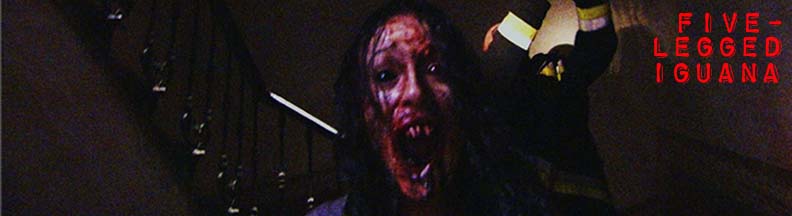
(Image courtesy of ssfilms.tv/thehamiltons/.)

Sunday, June 10, 2007


ENTOURAGE
Season 3 Episode 18
“The Resurrection”

It’s the day of the premiere of Five Towns on NBC, and the reviews are out, but Drama wants nothing to do with them, so he spends the day trying to relax. But it’s as he’s getting a “massage” that he succumbs to checking out the Variety review, much to his aggravation.
One confrontation with a TV reviewer later, and Drama’s in a proper funk.

Meanwhile, Turtle picks up Drama’s car, which the boys have had restored at Rufus’ Body Shop (Rufus, who got them their home system in Season 2, is now into cars, apparently). While waiting at the shop, Turtle meets Kelly, Rufus’ daughter, who’s also a sneaker freak. (Turtle later describes her as “… like me, but with tits.”)
One minor car crash later, and Turtle’s got himself a date.

Meanwhile still, Vince and E head into Ari’s office, and though Ari thinks the boys are back, they’re really only there to tell Ari to resuscitate Medellin. Knowing this is the one way he can get Vince back as a client, Ari ropes in Joe Roberts, producer of Matterhorn, the film Vince passed on way back in the Entourage pilot.
Apparently Matterhorn hasn’t gotten made yet, as Colin Farrell (who signed up to star in it) broke his arm weeks before filming was to start. So, seeing Vince’s fervent desire to do Medellin, Joe proposes a back-scratching: Vince does Matterhorn first, then they do Medellin.
But Vince still doesn’t want to do Matterhorn, and Roberts announces he’s considering buying the Medellin script. So Vince does what he can do: he decides to buy the Medellin script, with the long-term plan of producing the film himself. In what is one of the best scenes in the episode, E puts up every penny he has behind Vince’s scheme, once again confirming the depths of his friendship with Vince, and his faith in him.
And Vince is willing to put the Aquamansion up for sale just to buy the script.
One call to Roberts later (in which he talks about his days as a P.A. on Apocalypse Now), and Vince is the proud owner of 150 pieces of paper, and Ari’s got the prodigal client back.

Oh, and one pilot premiere later, and Drama’s in a hit TV show.

(Image courtesy of hbo.com.)

Saturday, June 9, 2007


VACANCY
(Review)

As if to pay homage to the granddaddy of all “loony in a motel” films, Vacancy opens* with what can be viewed as the 21st-century descendant of the Saul Bass-designed title sequence from Hitchcock’s Psycho, a sequence which coolly segues into the license plate of the car of Amy (Kate Beckinsale) and David Fox (Luke Wilson), a couple under the strain of an impending divorce.
It’s late, they’re lost, and the car’s beginning to look like it could be trouble. After apparently getting some help from a mechanic (Ethan Embry, goofy stoner Mark from Empire Records and the Jennifer Love Hewitt-yearning Preston from Can’t Hardly Wait), the Foxes eventually end up at the Pinewood Motel, overseen by its weirdo manager, Mason (Frank Whaley, fantastic in Keith Gordon’s A Midnight Clear and Thomas Carter’s Swing Kids).
They’re forced to spend the night at the ratty Honeymoon Suite, and when David can’t find anything on TV, he sticks in a VHS tape.
That’s when the fun starts.

Much as Eli Roth’s Hostel did, Vacancy uses the idea of torture and violence as a commercial venture as the springboard for its plot, and succeeds in giving its audience a tense and engaging thriller.
This is doubly interesting to me, as the film’s central idea is also a reflection on the fact that this kind of horror film (alternately called “torture porn”—from a phrase coined by New York Magazine’s David Edelstein—or my personal preference, “gorno”) is proving very profitable for Hollywood.
If the baddies of Hostel and Vacancy can make a quick buck off the misery and torture of hapless innocents, than why can’t Hollywood rip off audiences the world over with shrill screams and fake blood?
For any of you out there though who may take offense at anything called “torture porn,” let me assure you, Vacancy’s on-screen gore quotient is minimal in the extreme. There is violence of course, but not the sort of splatter movie violence where we see dismemberment and eye gouging and disemboweling. Vacancy is more thriller than gorno, and it’s a taut little bugger too.

What makes Vacancy even more effective is the fact that you become embroiled in this sullen, largely toxic relationship between husband and wife, played effectively by Beckinsale and Wilson. You feel the tension and the regret that this couple share, and you sense the spectre of the love that was once there.
You sympathize with them so much, that when the fit hits the shan, it’s actually a relief that they don’t devolve into hysterical recrimination. (After all, isn’t the fact that your lives are in danger far more important than anything else?)
It’s also a relief to see Beckinsale in something other than body-hugging black leather making out with Ben from Felicity, so if just for that, Amy Fox is a singular triumph.

If Vacancy has a weakness though, it can arguably be found in an ending that both soft pedals what came just before it, and perhaps in striving for realism (no protracted “psycho gets up after being stabbed/shot/mortally wounded to relentlessly stalk his victim” sequence here), director Nimrod Antal (Kontroll) and writer Mark L. Smith wind up crafting a climax that feels somewhat truncated.
That last shot had a feeling of: What?! That’s it?
Still, all in all, the ride getting to that final shot is worth it.
And if you’re not gonna give me much more than a good story about people in extreme, life-threatening situations (ie. no social or political commentary amidst the grue), then I’d much rather see an effective, if somewhat flawed, thriller than scene after scene of pointless blood and gore.

* It’s a savvy title sequence that’s one of the most interesting I’ve seen this year. (And that one sheet just slays, too.)

Parting shot: I love the conflation “gorno” (gore + porno), as it has that sleazy vibe to it, and a majority of the sub-genre’s titles strike me as violence for violence’s sake.
Don’t get me wrong, I love me a good horror film. Always have, always will.
But once you’ve seen Tobe Hooper’s Texas Chain Saw Massacre or Wes Craven’s The Hills Have Eyes, seeing other films of extreme violence (or, Heaven help me, seeing remakes of these classic films of extreme violence) just seems rather pointless, if they have nothing much more in their celluloid beyond the gore and grue.
Unless the point is to make a ton of money on a relatively low budget, which seems to be the case a lot of the time.
Now, when the film is a Hostel or a Saw, then I get it, and these are two of the films that give gorno its good name.
But when it’s a Turistas, or a Saw sequel, or a Texas Chainsaw remake (or prequel), or a Hills Have Eyes remake (or sequel remake), then these are the sort of films that give gorno its bad name.
And as you can see from the above sampling, they outnumber the goodies, believe me.

(Vacancy OS courtesy of wildaboutmovies.com.)

Friday, June 8, 2007


AFTERTHOUGHTS (10)

10.1 Congratulations to Heroes, Lost, Dexter, and Entourage, for snagging nominations at this year’s TV Critics’ Association Awards, specifically:

Heroes
New Program, Drama, and Program of the Year

Lost
Drama

Dexter
Individual Achievement in Drama (Michael C. Hall), and New Program

Entourage
Comedy

I’m jazzed about the nominations above, but I am saddened that Battlestar Galactica is nowhere to be seen on the nominations list.
I’m likewise appalled that Blood Ties was not recognized either.
(Kidding!)

Seriously, congratulations to one and all.
Winners are to be announced on July 21 at the TCA gala. Check out the complete nominee list at variety.com, or the TCA official website.

10.2 The first word about the handful of new additions to the second season of Heroes: Maya (played by X-Men: The Last Stand’s Callisto, Dania Ramirez); a 28-year-old black mother; a “sexy” boyfriend for Claire; an Irish mobster; and what SCI FI Wire termed a “surrogate” for Micah. (Not sure what that exactly means, but I guess a temporary guardian, given the criminal tendencies of both his parents?)
Maya’s powers are being kept under wraps for the moment, and she could be the only one of the new characters to be a regular. (Crap. Does that mean heartbreak for Claire? Or is he one of those Smallville “boyfriends,” who turn out to be evil in the end and have ulterior motives for wooing the girl?) It’s also unclear if the other 4 new additions will have powers as well, but that’s probably a safe bet.

(Images courtesy of comicbookresources.com [Heroes]; sparklies.org [Lost]; tv.com [Dexter]; and aol.com [Entourage].)

Wednesday, June 6, 2007


ON THE LOT
Film Premiere 2

The rules for this batch of short films: write, shoot, and edit a short film with a running time of not more than 3 minutes, in 5 days.
Now, for some reason, the show decides that they’ll be pitting five of the remaining 15 directors against each other, and the one whose film scores the lowest numbers of votes from the audience, goes home next week. I’m curious to know though how the five directors were determined, or was it all totally random (which somehow, I don’t think is the case, ‘cause if it were random, they could’ve just pulled names out of a hat right then and there).

Anyway, with a field of five, I’m choosing to forego my usual alphabetical rundown of the short films that comprised my middle pack (neither my favorites nor my un-favorites) and cruise through the five films, going from my favorite to my un-favorite.
So without further ado…

MY FAVORITE: Adam Stein’s “Dough: The Musical”
An inspired and delightful tale of a baker searching for a woman to wed, and a girl searching for a job to pay the rent.
Not only does Stein display his songwriting skills (always good to wear a lot of hats in Hollywood), but he’s got some interesting wordplay with the title going, to reflect how two people looking for two entirely different things can come together and discover mutual satisfaction.
This one’s funny and heartfelt, and if I have one complaint, it’s that the actors’ lipsynching skills aren’t completely convincing. (I’m a lipsynching stickler, sue me.)

Sam Friedlander’s “Broken Pipe Dreams”
Ingenious short about a man with a toilet bowl trauma (see it to believe it) losing an engagement ring to the porcelain god.
After getting me solidly in his camp with one of my favorites last week (“Replication Theory”), Friedlander has fun with Mission: Impossible and moves the audience with the apparent death of a fish. I can safely say I’ve never spent any previous 3 minutes of my life quite like this.

Shalini Kantayya’s “Laughing Out Loud: A Comic Journey”
The life of a gay Hindu stand-up comic, just before he has his first big show.
This one was the only short film of the batch that tended more towards the dramatic than the comedic, though it does play like a confessional camera piece, and the final advice, “Be yourself” is sort of really Hallmark-y and trite. (Carrie Fisher said it a lot more nicely and without the snarky tone.)
Of the five, this was also the one that looked most like a music video/advertisement, thus gaining guest judge Michael Bay’s vote.
It was moving though…

Trever James’ “Teri”
Another funny blind date short, this one is passably entertaining, till we get to the end.
While Kantayya’s effort had an ending we’d pretty much seen before, “Teri” has sort of a non-ending, as all Ben’s nightmares about his blind date evaporate into the aether when the nice-looking, normal Teri shows up at his door.

MY UN-FAVORITE: Hilary Graham’s “The First Time I Met The Finkelsteins”
Once again, Graham ends up an un-favorite with this “first dinner with potential in-laws” concoction. Just as real-life dinners of this sort can turn out, this one’s a disaster.
The end result is just coarse and unappealingly vulgar. Of course, that’s because the Finkelsteins are coarse and unappealingly vulgar, but then again, this is from the woman who gave us “Bus #1” (where a woman just really urgently needs to pee), so you gotta wonder, why is she still here when Phil Hawkins was sent home last week?

I learned two things from this episode: that having Friedlander and Stein on my lookout list was so on the money, and that Michael Bay talks like he’s a director who’s far more talented and gifted than his films actually indicate.
Who knows, maybe he is, but dude, lighten up. You were only on the show to promote Transformers anyway, right?

Parting shot: Due to its less than stellar ratings, On The Lot has been pared down to one episode a week.

(Contestant image courtesy of thelot.com; Michael Bay image courtesy of movies.yahoo.com.)

Saturday, June 2, 2007


AFTERTHOUGHTS (9)

9.1 Congratulations to Neil Marshall, whose film The Descent (or more precisely, its trailer) nabbed the award for Best Thriller at the 8th Annual Golden Trailer Awards. The Descent also won for Best Horror Poster.
Other notable winners:

Trailers
Best Action: 300
Best Drama: The Departed
Best Documentary: This Film is Not Yet Rated
Best Voice Over: Grindhouse
Best of Show: 300
Best Sound Editing: Little Children
Best Motion/Title Graphics: Transformers: Teaser
Best Anime Trailer: Paprika

TV Spots
Best Comedy: Stranger Than Fiction: Cards

Movie Posters
Best Thriller: Hard Candy
Most Original: Premonition*
Best International: The Prestige

Congratulations to all involved, particularly the companies and ad groups responsible for the trailers, teasers, and one sheets. Check out the complete list of winners at the official GTA website.

9.2 So, after that song-and-dance by Edward James Olmos and David Eick (see Afterthoughts (7) and (8): Archive: May 2007), it seems that Battlestar Galactica really is cruising off into the great beyond at the end of season 4.
Ah well, there’s still 22 more episodes and that Pegasus TV movie before I have to break out the mourning veil…

* Yes, this is one of those cases where I liked the one sheet a hell of a lot more than the movie itself. (This also happens with trailers, where that minute and a half is sometimes so much more kick-a$$ than that excruciating hour and a half plus change.)

(OS’s courtesy of horrorphile.net [The Descent, Hard Candy] and wildaboutmovies.com [Premonition, The Prestige].)

Friday, June 1, 2007


ROHTENBURG
(aka GRIMM LOVE)
(Review)

Katie Armstrong (Felicity herself, Keri Russell) is an American graduate student in Germany, whose chosen thesis subject is the case of Oliver Hartwin (Thomas Kretschmann, most widely known for his role as Captain Englehorn in Peter Jackson’s King Kong), who found a willing victim in Simon Grombeck (Thomas Huber, seen in the live action Aeon Flux), and ate him.
This is the chillingly gruesome premise of Martin Weisz’s first feature film, Rohtenburg (Grimm Love in the US, where it is currently on the festival circuit), a disturbing portrait of that dark territory where the positive, life-affirming traits of love, collide with the self-destructive tendencies of the disturbed and the deranged.
After establishing himself firmly in the commercial and music video worlds, Weisz delivers a solid and controversial debut, which ended up getting banned in Germany.

Relying largely on flashbacks, we accompany Katie on her journey of discovery as she travels the footpaths and backroads of Oliver’s and Simon’s lives, to perhaps better understand what led them to that place and time where one allowed the other to eat him, in order to consummate their love.
And with the largely chronological nature of the flashbacks, it quickly becomes apparent that the script by T.S. Faull is moving inexorably towards Katie’s viewing of the video Oliver shot of the death of Simon, an act that will perhaps allow her to fill the hole in her life left by some undisclosed loss. Katie believes that if she can somehow come to understand the truth behind that singular confluence where Oliver and Simon found each other, then perhaps she can come to grips with her own personal darkness.

With haunting music by Steven Gutheinz and the bleak, cold beauty of Jonathan Sela’s cinematography*, Rohtenburg is a riveting descent into the damaged lives of lonely, scarred individuals, who are only really yearning for that one particular other who can make them feel safe, and whole, who can understand them completely, who can look into their souls and not flinch from the abyss that waits there.
With strangely similar family backgrounds (estranged father, mentally unstable mother), Oliver and Simon seem like nothing so much as mirror selves, merely waiting for fate to allow them to see the other’s reflection, and to let them heal each other in the dark, ghoulish manner which they desire.

Kretschmann is hypnotic as the schizophrenic Oliver, who embraces the macabre urges that roil inside him, who, in his youth, only ever experienced giving—in his round-the-clock caring for his mother—can now really only take, to satisfy the child perpetually starved of affection. (His plea for more willing victims over the internet is simply the child in the candy shop, demanding more sweets.)
Huber meanwhile, is the sad and desperate picture of the secret victim, who tries to maintain a normal relationship with lover Felix (Marcus Lucas), while trawling the net in the early morning hours, visiting websites like the Cannibal Cantina, to sate his deviant hungers. And while Oliver’s need is to absorb, Simon’s is to be absorbed, to be completely subsumed—and more pointedly, consumed—by the act of love. (One of the most disturbing moments of the film—and there are many—is when Simon tells a male prostitute what he wants done to his penis.)
And as clearly warped and twisted as these psyches are, when they meet over the internet, there is a mutual, instinctual understanding that they have indeed found their other. It is one of Rohtenburg’s triumphs that the flurry of emails back and forth between Oliver and Simon is both a heartfelt exchange and a wildly disturbing taste of the extremes to which some people will go to find love.

And as witness to this bizarre relationship, Russell is effective as the audience’s proxy, also damaged and scarred by life (though perhaps not as much as either Oliver or Simon), trying to scry for the truth in the shadowed mirror of a love soured by death, of a union where eros and thanatos lay in each other’s arms, whispered sweet nothings into each other’s ears, then proceeded to sink their teeth into each other’s haunches.

Clearly, Rohtenburg is not to everyone’s tastes (pun most definitely intended). The material is decidedly dark and morbid.
But it is also imbued with a Gothic lyricism that never allows the film to become sordid and tawdry in the way other movies of the bizarre from last year—notably Terry Gilliam’s Tideland and Gyorgy Palfi’s Taxidermia—are.
While other films seem more content to repulse and revolt, Rohtenburg’s aim is to disturb and provoke. Where is the line that separates right from wrong where love is concerned? Consenting adults, after all. And these are the people their pathologies have made them into. This is their understanding of “love.” What right does society have to say otherwise?

Perhaps the saddest note in all this though, is the fact that Weisz went from horror with significant subtext to The Hills Have Eyes 2 (review in Archive: April 2007), exactly the sort of movie whose only real purpose is to repulse and revolt. Given what he achieved in Rohtenburg, I can only hope The Hills Have Eyes 2 was an aberration, and that his next film will have as much, ahem, to chew on, as Rohtenburg does.

* Jonathan Sela’s excellent cinematography can also be seen in John Moore‘s remake of The Omen, and in the upcoming film adaptation of Clive Barker’s Midnight Meat Train.

Parting shot: Rohtenburg earned Wiesz the Best Director nod at the 39th Sitges International Film Festival (Europe’s biggest fantasy-horror fest). It also snagged the Best Actor award, shared between Kretschmann and Huber, and Best Cinematography for Sela.

Parting shot 2: Rohtenburg is inspired by the real life case of the Metzgermeister (“Master Butcher”), Armin Meiwes. It was Meiwes’ complaint that his “personality rights” had been violated that resulted in the German ban.

(Rohtenburg and Grimm Love OS’s courtesy of impawards com; film image courtesy of bilder.filmstarts.de.)