Showing posts with label documentary. Show all posts

Tuesday, February 1, 2022

WOODLANDS DARK AND DAYS BEWITCHED: A HISTORY OF FOLK HORROR (March 2021)


WOODLANDS DARK AND DAYS BEWITCHED:
A HISTORY OF FOLK HORROR
(March 2021)

“Folk horror very much channels people’s relationship to the land, to this sort of shared consciousness, these traditional beliefs that are somehow in the soil, in the landscape.
--Kat Ellinger
   Editor, Diabolique Magazine
 
Writer/director Kier-La Janisse brings us the incisive and absorbing 3-hour plus documentary Woodlands Dark and Days Bewitched, which is, as its subtitle indicates, an expansive study of folk horror, from its literary roots onto its notable presence on both the film and television mediums.
 
“Like any decent piece of work, [The Wicker Man] survives. It has, coiled at the heart of it, a mystery. Peter Pan has it. It’s overtly a very silly play. But it isn’t, because it’s about something other than what its surface purports to be.”
--Anthony Schaffer
   Writer, The Wicker Man
 
If you’re the sort of horrorhead who loves to delve beneath the surface, who is (to use a morbidly appropriate analogy) drawn to rummage amidst the bloody innards of the slaughtered sacrificial lamb to see what makes it what it is, to study its innate lamb-ness as it were, then Woodlands… is, as they say, a “must-see”.
 
“Generally speaking, we wanna believe that the thoughts and fears and beliefs of a past generation, we’ve sort of transcended them, we’ve grown out of them, we’re above them. Horror films always pose this problem that in fact, it’s not as simple as that.”
--John Cussans
   Author, Undead Uprising: Haiti, Horror and the Zombie Complex
 
There’s a host of experts and writers and filmmakers interviewed during its runtime, and a whole bunch of films are touched on, including a number of personal favorites and titles that have been mentioned ‘round these parts.
As such, I could just go on and on with the quotes, but I imagine I should just leave you with this…


“So I think it’s super-interesting how these myths are, like, all around the world, they just have different names, and we make it local.”
--Abraham Castillo Flores
   Head Programmer, Morbido Film Festival
 
The fifth (and penultimate) chapter of the documentary, “All the Haunts Be Ours: Folk Horror Around the World,” is a key section that further expounds on the definition of folk horror and expands its borders to make room for a more diverse catalogue of titles beyond the usual suspects like The Wicker Man.
 
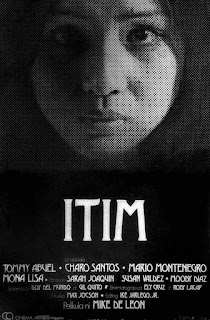
It’s somewhere towards the end of that section though, that I was starting to despair of seeing any kind of Philippine representation, when lo and behold, the film I consider, hands down, the best horror film our shores have managed to produce (and by this, I also mean it’s one of the best horror films ever made, regardless of country of origin) appears here under its international title, The Rites of May.
Go, Mike de Leon!
 
So, yes, check this out if you’ve a mind to, as it also makes the sobering case for the timeliness of folk horror in this very fraught moment in our race’s history…
 
“And ‘We don’t go back’ is the fundamental tension of folk horror.”
--Howard David Ingham
   Author, We Don’t Go Back: A Watcher’s Guide to Folk Horror
 
(Woodlands Dark and Days Bewitched: A History of Folk Horror Blu-ray cover art courtesy of bloody-disgusting.com; Itim OS courtesy of imdb.com.)

Saturday, November 28, 2015


¡QUÉ HORROR2016
Candidate #3

WHY HORROR?
(October 2014)


"Horror has come a long way since it first got its hooks into me. As a devout fan, I used to feel like an outsider, but these days, I meet fans everywhere I go.
“Horror is now more popular than it’s ever been.”
--Tal Zimerman

I could be wrong and memory is f*cking with me right now, but I think this is the very first actual doc that’s made its way to ¡Q horror! Candidacy (as opposed to the occasional faux doc that’s made the rundown).
Rob Lindsay and Nicolas Kleiman’s Why Horror? follows long-time horrorhead Tal Zimerman as he explores his life-long fascination with the genre, asking the titular question, “Why horror?” of art historians and literature experts and language professors and psychologists, as well as a host of familiar genre faces, from the old school vanguard (John Carpenter, Don Coscarelli, George Romero) to current established names (Alexandre Aja, Simon Barrett, Eli Roth, Ben Wheatley).

For any audience member who happens to be a kindred spirit to Tal, the game-changing benchmarks of a lifelong horrorhead of a certain generation--such as the socio-political horror of Romero’s original zombie trilogy, giallo, the home video boom, the self-referential metahorror of Scream, J-Horror, found footage, and the digital revolution sparking the current wave of global horror--are all touched on in the great animated section “A Way Too Brief History of Horror Cinema” (with VO from one of our all-time favorite hobbits, Elijah Wood).
There’s even the acknowledgement that, yes, Virginia, there are actually female horror fans (who make horror films too!), with appearances by the Soska sisters and Karen Lam.

For the more critically-minded horrorheads out there, or, for those who, at the very least, are curious to dig at the possible roots of their fascination with the genre, Why Horror? is an excellent and highly recommended watch that smartly encapsulates just how deeply horror is entrenched in our humanity, and how it’s really a universal language that we all know.
The question is, just how fluent are we willing to be in it?

“I like ‘smarts.’ I just like intelligent views of the world. And I am deeply committed to finding ‘smarts’ where other people don’t think to look for it. And I think horror is the perfect place.”
--Dr. Susanne Kord
European Languages, Culture and Society
University College, London, England

(Why Horror? OS courtesy of shocktillyoudrop.com.)

Tuesday, November 11, 2008


AMERICAN ZOMBIE
(Review)


“They go by different names: decedents, the non-living community, revenants, the living dead, zombies. But, whatever they are, they are real.”


One of the most atypical—and most effective—of cinema’s recent zombie entries has to be Grace Lee’s faux documentary, American Zombie.
Tracking the lives of four “revenants” in a world where the living dead exist and take the bus just like everybody else, American Zombie is one of the most imaginative takes on the subject matter I’ve seen, and humbly follows in the hallowed footsteps of Romero’s brand of undead social commentary.

Here, zombies stand in for anyone who’s been marginalized, abused, and disabused, the disenfranchised and alienated of society, regardless of race, creed, or colour.
All we really want, after all, is to understand and accept who we are, and be embraced for that; to love and to be loved.
That goes for zombies too.

“We’ve made three classifications that define the revenant population.
“The first classification is the feral zombie, which are beings that seem to function without reason.
“Second is low-functioning zombies. These are beings that have limited mental capacity, but they’re perfectly capable of caring for themselves.
“And the third is high-functioning zombies. These beings have vast portions of their mental facilities intact, and it’s not unusual for them to pass as humans.”


The parallels with the real world are plain to see, from people living with a potentially catastrophic, communicable disease, to an abused labour force without rights or privileges, to “an untapped market for spiritual enlightenment.”
I have seen zombies, my friends, and in American Zombie, the zombies are us.

The “high-functioning” cross-section Lee chooses to people her documentary with include Ivan (Austin Basis), a convenience store clerk who puts out a ‘zine called American Zombie; Judy (Suzy Nakamura), a customer relations rep for Healthful Bounty, an organic food company; Lisa (Jane Edith Wilson), a would-be artiste/florist (specialization: funeral arrangements) who has no memory of her former life and death; and Joel (Al Vicente), founder of ZAG, the Zombie Advocacy Group (“We’re here. We’re dead. Get used to it.”), who pronounces his name “Yo-El.”
It’s through their stories that Lee moves the audience over a gamut of emotions, a more varied palette of feeling than that offered by many a one-tone horror movie.


And yes, American Zombie is a horror movie, though not the sort with buckets of fake blood and rubber entrails.
Here is, at the risk of setting off the pretention alarm, the horror of existence: the horror of loneliness, and rejection, and aimlessness, and prejudice, and injustice.
It’s the horror of being invisible, of being treated—for whatever reason—as a second-class citizen, without the right to rent property, or to vote, or to marry.

“Jesus loves zombies. Jesus was the original zombie.
“I’m sure, you know, some really strict theologian would have some problems with that, but, but I say it, you know, I say it to kind of, wake the zombies up. You know, to let the zombies know that, ‘Hey, you’re not alone. You know, Jesus has been through the same thing.’”


Lest I’m making American Zombie sound, heh, deathly serious, let me assure you, there’s a healthy streak of humour here too, thus, that gamut of emotions I mentioned earlier.
The mere set-up alone allows for an amusing laugh or three: real life documentarian Grace Lee—who’s tackled weighty subject matter like military prostitution and sweatshop workers’ rights—plays herself in a documentary about zombies (which sort of reminds me of Werner Herzog appearing as himself in Zak Penn’s Incident at Loch Ness).
Tell me that doesn’t sound funny.


The beauty of American Zombie though, is that, as funny as it is, it also succeeds in drawing out some of the sad truths of who we are, not just as a society, but as thinking, feeling individuals as well.
This is what any good documentary should do. The fact that Lee achieves this in a fake documentary, with a premise that sounds as patently ridiculous as this one does… well…
“Triumph” is the word, people.
It’s a piece like this that makes me glad zombies are still living it up on the silver screen.

“We can’t pretend they don’t exist. They exist. They deserve our attention. It’s not a disease, it’s not a disability. It’s a new population, a population that deserves our respect and social services.”

(American Zombie OS courtesy of impawards.com and images courtesy of americanzombiemovie.com.)