Showing posts with label tilda swinton. Show all posts

Tuesday, October 1, 2019


13 Slots for the Best Horror I've Seen in the Past Year
[3 of 13]
The Danse Macabre Slot

So yes, since both these films have dance as a central narrative element, they're sharing a slot...
 

CLIMAX
(May 2018)


Gaspar Noé’s* self-described "catastrophe movie with dancers," Climax is an interesting entry in the “Cinematic Experience as Endurance Test” horror movie category.
In it, we witness a group of dancers have the Worst. Night. Ever. thanks to an external trigger that shall remain unidentified here.

The fact that the trigger is a very real and possible occurrence also makes Climax the kind of horror film that doesn’t need ghosts or demons or vampires or masked slashers or (Heaven forbid) zombies to make its case, but instead, is a chillingly disturbing example of Sartre’s observation "L'enfer, c'est les autres!" (“Hell is other people!”).

Hell is also a gradual, hypnotic, dizzying, alluringly repulsive descent into chaos.

But while all of the above may be true, it must also be pointed out that Hell has a slammin’ soundtrack!


[Climax is] all about people creating something together, and failing in the second half. It’s like the story of the Tower of Babel. Mankind can create big things. And then with the influence of alcohol, or some accident, everything falls.
--Gaspar Noé

* Noé has pointed to titles like ‘70’s disaster films The Towering Inferno and The Poseidon Adventure, as well as David Cronenberg’s Shivers as some of the inspiration that fueled Climax.

SUSPIRIA
(September 2018)


"They are professional performers. Illusion is their craft.”

The best word I can come up with for Luca Guadagnino’s Suspiria (billed as “Six Acts and an Epilogue Set in Divided Berlin”), is reimagining.
While the opening credits tell us that the script by David Kajganich is still “Based on the Original Screenplay by Dario Argento and Daria Nicolodi,” this Suspiria takes the bare narrative bones of a young American accepted to a dance academy that hides a sinister secret, and lushly fleshes it out, in both theme and character, giving us something at once familiar, and yet bracingly, beguilingly new.
Or, to use the appropriate metaphor, it’s generally the same dance, but it’s set to a different tempo, so it’s got a different rhythm, and it boasts some new, brazenly daring choreography.

“When you dance the dance of another, you make yourself in the image of its creator. You empty yourself, so that her work can live within you.
“Do you understand?”

Some of those new steps are immediately introduced to us.
Even before Susanna Bannion of Ohio (Dakota Johnson) is welcomed into the Helena Markos Tanzgruppe, we meet Josef Klemperer (“Lutz Ebersdorf”**), psychiatrist to Chloë Grace Moretz’s Patricia Hingle (a name that should ring some bells from the original).


And while Argento bound himself largely to the dark fairy tale setting of the Tanz Academie, Guadagnino and Kajganich choose to frame the action against historical events in a “Divided Berlin,” tossing politics (including sexual), societal upheaval, and the long, twisted shadow of the Holocaust into this witches’ brew.
With a full hour more running time than the original, this Suspiria uses that additional time masterfully so motivations come more clearly into focus, and dance becomes even more pivotal and central to the narrative.

“Movement is never mute. It is a language. It’s a series of energetic shapes written in the air like words forming sentences.
“Like poems.
“Like prayers.”

Dance as magick.
Movement as vector for intent and desire, unleashing power more potentially destructive than bombs.
These come forcefully to the surface in this reimagining, as does Argento’s Three Mothers mythology.
As Klemperer recounts:

“Patricia wrote about ‘Three Mothers,’ lost in time, predating all Christian invention. Pre-God. Pre-Devil.
“Mother Tenebrarum, Mother Lachrymarum, and Mother Suspiriorum.
“Darkness, Tears, and Sighs.”

We may not be treated to the added layer of their three Houses just yet, but the basic mythological foundation is here for our inspection.
All these, and more, all discrete steps in this shadowy dance, which builds steadily, crescendoing in a completely batsh!t Grand Guignol finale, before segueing into a surprisingly moving Epilogue.
(Plus, Argento’s Suzy Bannion, Jessica Harper, makes a crucial appearance!)


While it’s safe to say that this was clearly another very serious instance of “Manage Your Expectations, Space Monkey,” I am relieved to announce that this is a dance I was very glad to have witnessed.

“You can give someone your delusion, Sara. That’s religion.”

** I could go on about the whole Tilda Swinton of it all (and she is amazing here, as always), but that would just detract from the whole, so let’s just leave that where it is, and simply bathe in the witchy glow of this powerful and potent “reimagining” without those added distractions.


Parting Shot: Reviews for Argento’s original “Three Mothers” trilogy can be found here, here, and here.
Given my opinions of Inferno and La Terza Madre, I honestly wouldn’t mind some more reimaginings of this type.

Parting Shot 2: Kajganich also wrote the script for The Invasion (review here), but that was butchered thanks to studio/test audience interference, so we’re not holding that against him.
He also co-wrote the script for the Pet Sematary remake, from Starry Eyes’ Kevin Kölsch and Dennis Widmyer. (Definitely another case of “Manage Your Expectations, Space Monkey.”)

(Climax & Suspiria OS’ courtesy of impawards.com.)

Wednesday, January 16, 2019


¡QUÉ HORROR2019
Candidate #10

SUSPIRIA
(September 2018)


"They are professional performers. Illusion is their craft.”

The best word I can come up with for Luca Guadagnino’s Suspiria (billed as “Six Acts and an Epilogue Set in Divided Berlin”), is reimagining.
While the opening credits tell us that the script by David Kajganich is still “Based on the Original Screenplay by Dario Argento and Daria Nicolodi,” this Suspiria takes the bare narrative bones of a young American accepted to a dance academy that hides a sinister secret, and lushly fleshes it out, in both theme and character, giving us something at once familiar, and yet bracingly, beguilingly new.
Or, to use the appropriate metaphor, it’s generally the same dance, but it’s set to a different tempo, so it’s got a different rhythm, and it boasts some new, brazenly daring choreography.

“When you dance the dance of another, you make yourself in the image of its creator. You empty yourself, so that her work can live within you.
“Do you understand?”

Some of those new steps are immediately introduced to us.
Even before Susanna Bannion of Ohio (Dakota Johnson) is welcomed into the Helena Markos Tanzgruppe, we meet Josef Klemperer (“Lutz Ebersdorf”*), psychiatrist to Chloë Grace Moretz’s Patricia Hingle (a name that should ring some bells from the original).


And while Argento bound himself largely to the dark fairy tale setting of the Tanz Academie, Guadagnino and Kajganich choose to frame the action against historical events in a “Divided Berlin,” tossing politics (including sexual), societal upheaval, and the long, twisted shadow of the Holocaust into this witches’ brew.
With a full hour more running time than the original, this Suspiria uses that additional time masterfully so motivations come more clearly into focus, and dance becomes even more pivotal and central to the narrative.

“Movement is never mute. It is a language. It’s a series of energetic shapes written in the air like words forming sentences.
“Like poems.
“Like prayers.”

Dance as magick.
Movement as vector for intent and desire, unleashing power more potentially destructive than bombs.
These come forcefully to the surface in this reimagining, as does Argento’s Three Mothers mythology.
As Klemperer recounts:

“Patricia wrote about ‘Three Mothers,’ lost in time, predating all Christian invention. Pre-God. Pre-Devil.
“Mother Tenebrarum, Mother Lachrymarum, and Mother Suspiriorum.
“Darkness, Tears, and Sighs.”

We may not be treated to the added layer of their three Houses just yet, but the basic mythological foundation is here for our inspection.
All these, and more, all discrete steps in this shadowy dance, which builds steadily, crescendoing in a completely batsh!t Grand Guignol finale, before segueing into a surprisingly moving Epilogue.
(Plus, Argento’s Suzy Bannion, Jessica Harper, makes a crucial appearance!)


While it’s safe to say that this was clearly another very serious instance of “Manage Your Expectations, Space Monkey,” I am relieved to announce that this is a dance I was very glad to have witnessed.

“You can give someone your delusion, Sara. That’s religion.”

* I could go on about the whole Tilda Swinton of it all (and she is amazing here, as always), but that would just detract from the whole, so let’s just leave that where it is, and simply bathe in the witchy glow of this powerful and potent “reimagining” without those added distractions.


Parting Shot: Reviews for Argento’s original “Three Mothers” trilogy can be found here, here, and here.
Given my opinions of Inferno and La Terza Madre, I honestly wouldn’t mind some more reimaginings of this type.

Parting Shot 2: Kajganich also wrote the script for The Invasion (review here), but that was butchered thanks to studio/test audience interference, so we’re not holding that against him.
He also co-wrote the script for the upcoming Pet Sematary remake, from Starry Eyes’ Kevin Kölsch and Dennis Widmyer, so I’m keeping my fingers crossed for that one. (Definitely another case of “Manage Your Expectations, Space Monkey.”)

(Suspiria OS’ courtesy of impawards.com.)

Tuesday, October 9, 2012


A Rundown of the 13 (plus) Best Horror Movies I've Seen in the Past Year
[7 of 13]


WE NEED TO TALK ABOUT KEVIN
(May 2011)


Care for a double bill that can potentially work far better than rubbers or the pill to effect birth control?
Try pairing past ¡Qué Horror! title, George Ratliff’s Joshua, with Lynne Ramsay’s We Need to Talk About Kevin.


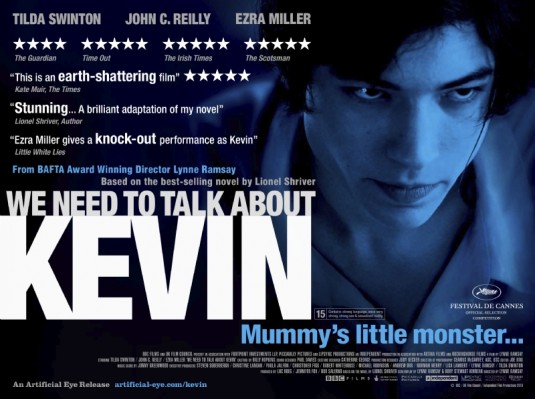
A powerful and terrifyingly chilling entry in the annals of bad seed cinema, We Need to Talk About Kevin is based on Lionel Shriver’s novel, and is so good, that it got Shriver’s seal of approval, as evidenced on the UK quad above.
With a painfully exquisite performance by Tilda Swinton (who was nominated for a Golden Globe for the role, but snubbed by Oscar) as Eva Khatchadourian, and an appropriately “f*cker’s so smug you wanna just slap him silly” turn by Ezra Miller as her fundamentally disturbed son, the eponymous Kevin, We Need to Talk About Kevin is a grim depiction (made even more harrowing by its non-linear narrative structure) of just how wrong raising a child can turn out, and how the ultimately selfish acts of willful and unmindful children impact and reflect on the adults in their vicinity.


Parting shot: Though I love the devil baby OS above, I feel I need to stress that, like Joshua, there is nothing remotely supernatural about the situation in We Need to Talk About Kevin, which, of course, makes it all the more disturbing.

(We Need to Talk About Kevin OS’ and UK quad courtesy of impawards.com.)

Monday, July 2, 2012


¡Qué horror! 2012
Candidate # 19

WE NEED TO TALK ABOUT KEVIN
(May 2011)


Care for a double bill that can potentially work far better than rubbers or the pill to effect birth control?
Try pairing past ¡Qué Horror! title, George Ratliff’s Joshua, with Lynne Ramsay’s We Need to Talk About Kevin.


A powerful and terrifyingly chilling entry in the annals of bad seed cinema, We Need to Talk About Kevin is based on Lionel Shriver’s novel, and is so good, that it got Shriver’s seal of approval, as evidenced on the UK quad above.
With a painfully exquisite performance by Tilda Swinton (who was nominated for a Golden Globe for the role, but snubbed by Oscar) as Eva Khatchadourian, and an appropriately “f*cker’s so smug you wanna just slap him silly” turn by Ezra Miller as her fundamentally disturbed son, the eponymous Kevin, We Need to Talk About Kevin is a grim depiction (made even more harrowing by its non-linear narrative structure) of just how wrong raising a child can turn out, and how the ultimately selfish acts of willful and unmindful children impact and reflect on the adults in their vicinity.


Parting shot: Though I love the devil baby OS above, I feel I need to stress that, like Joshua, there is nothing remotely supernatural about the situation in We Need to Talk About Kevin, which, of course, makes it all the more disturbing.

(We Need to Talk About Kevin OS’ and UK quad courtesy of impawards.com.)

Monday, February 25, 2008


AFTERTHOUGHTS (54)
HEY, IF IT ISN’T OSCAR! 2008 (3)

So Oscar’s 80th has come and gone, and first off, here are the wins that had me cheering…

No Country For Old Men:
Best Picture
Best Director (Joel & Ethan Coen)
Best Supporting Actor (Javier Bardem)
Best Adapted Screenplay (Joel & Ethan Coen)

Once:
Best Song (“Falling Slowly”)

The Golden Compass:
Best Visual Effects (Michael Fink, Bill Westenhofer, Ben Morris, and Trevor Wood)

Juno:
Best Original Screenplay (Diablo Cody)

Sweeney Todd: The Demon Barber of Fleet Street:
Best Art Direction (Dante Ferretti, Art Direction; Francesca Lo Schiavo, Set Decoration)

So, yeah, it’s still a sad thing that Zodiac didn’t get any love, and yes, it’s another sad thing that both Away From Her and Eastern Promises went home statue-less, but the night had some great surprises too.
Firstly, though I haven’t seen Michael Clayton, I’ve been a big fan of Tilda Swinton for ages, so I’m jazzed that she got Best Supporting Actress.
And while I’m happy The Golden Compass took Best Visual Effects (I was concerned either of the two box office juggernaut nominees would steal the award), and No Country For Old Men got a goodly amount of statues, the best bit of the night for me was “Falling Slowly” standing triumphant in the Best Original Song dust-up.
And when Jon Stewart brought Marketa back so she could speak her piece, well, that made the win and the moment even more precious.

Congratulations, one and all. (You can find a complete list of the night’s winners here.)

Parting shot: Was it just that I blinked and missed it, or were Roy Scheider and Brad Renfro really absent from the In Memoriam montage? (‘Cause if they were, shame on you, Oscar…)

Parting shot 2: Reviews of Away From Her, Eastern Promises, The Golden Compass, Juno, No Country For Old Men, Once, Sweeney Todd: The Demon Barber of Fleet Street, and Zodiac can be found in the Archive.

(The Golden Compass OS courtesy of aintitcool.com; all other OS’s courtesy of impawards.com.)

Monday, August 27, 2007


reVIEW (21)
CONSTANTINE

Don’t believe the travel brochures.
Hell’s a great place to visit. Really. And you don’t even need a visa, just a container of water and a cat in your lap.
Just take a look at Constantine, a film which kicks off (after some short preliminaries) with an exorcism in a Filipino community in L.A., a sequence designed to firmly establish that this is NOT your father’s Exorcist. No creaky old Max Von Sydow chanting “The power of Christ compels you…” here; in this movie, all you need to smite some demon butt is a mirror and Keanu Reeves.

Based on Hellblazer, the DC comic from its Vertigo line of titles (non-superhero, and geared to a more mature audience), Constantine pretty much captures a certain aspect of the comic: the backstreet, DIY nature of John Constantine’s brand of magic—no chanting, no rituals, and no explanations. Stick your feet (still in their shoes, mind you) in a container of water, and presto, you get to visit Hell. Why? Because it works that way.
Now, in the comic, these little tricks fly because the writers and artists are able to create a world where stuff like this actually makes some strange sort of sense, a world where the bizarre belongs. A world with atmosphere.
Tragically, Francis Lawrence, who directed Constantine, is the kind of music video director who thinks atmosphere is something you see, rather than feel, the kind of music video director who seems to be after the pretty shot, and not much else.*

Take the film’s Hell. It’s got that post-apocalyptic L.A. After the Bomb look, with lots of open-headed CGI nasties scrambling about, but it doesn’t really convey a true sense of the Kingdom of Pain, no brimstone whiff of genuine Hellishness. The Mongolian hordes on a Sunday at Megamall are far more vicious and intimidating. Now that’s what I call “Hell.”
And, granted, the film does have its moments (Constantine battling demon half-breeds in a rain of holy water; the divine Tilda Swinton’s Gabriel getting down to business; Shia LaBeouf‘s Chas, in his final, post-end credits shot), but they’re too few, and too far between, to make any real sort of impact on the whole; a whole that ends up being a badly-paced, plodding affair, with a plot of the connect-the-dots school: bump off minor characters A and B to get major characters C and D to points E and F.

Now, though I’m dead certain there’ll be Hellblazer fans out there who’ll belabor the point that this is not the John Constantine of the comic book, that, Heavens to Murgatroid, Constantine isn’t even American, personally, I think the real problem is more that Constantine wasn’t just turned into any old Yank, he was turned into… duuude… Keanu!
Though I’ve managed to enjoy some films despite his presence (The Matrix, Bram Stoker’s Dracula, Dangerous Liaisons), Reeves simply doesn’t have either the acting chops or the gravitas to pull off the complexity of John Constantine, the likeable rogue, the anti-hero scoundrel haunted by far too many ghosts, playing both sides off against the middle, trying to buy his way into Heaven while struggling to keep just one step ahead of the Reaper. None of that is in evidence here. Instead, all he does is smoke, add a husky register to his voice, and look testy and vaguely constipated.

And though Rachel Weisz (of The Mummy films) tries gamely to give dimension to her conflicted Catholic cop Angela Dodson, she suffers, acting opposite the likes of Reeves. Performance-wise, the high points of Constantine are Tilda Swinton (Young Adam, The Deep End), whose androgynous beauty is perfect for Gabriel, and Pruitt Taylor Vince (Identity, S1m0ne) as Father Hennessy.
The rest of the cast are sabotaged, either by a script that leaves their characters underdeveloped and unexplored (like LaBeouf‘s Chas, who comes off as too much the loyal, eager puppy ready to learn), or because they’re forced to act alongside you-know-who.
Then of course, there’s Gavin Rossdale. Casting Bush’s front man as demon half-breed Balthazar might have been a good idea, if Rossdale could actually carry a scene, but there’s just too much of the preening rock star in him; he’s not acting, he’s performing. The confrontation between Constantine and Balthazar towards film’s end is a bizarre moment where the audience is watching the collision of a quasar and a black hole. I have no idea what that is in astronomical terms, but it’s something I don’t care to see again.
And please, don’t get me started on Peter (Spun, Fargo) Stormare’s Devil.

In the end, Constantine isn’t a complete loss. Like I said, it has its moments, and you do get to visit Hell without all the unpleasantness advertised in the brochures.
Just don’t expect too much, and Heavens to Murgatroid, don’t expect Hellblazer.
Do that, and you may actually not regret having seen the film.

* Please don’t think I’m being a snob here. There are video directors out there who understand atmosphere: David Fincher (Fight Club), Spike Jonze (Being John Malkovich), Mark Romanek (One Hour Photo), Michel Gondry (Eternal Sunshine of the Spotless Mind). Lawrence, though…

(Constantine OS courtesy of impawards.com.)

(The above is a slightly altered version of a previously published review entitled “To Hell and Back.”)