Showing posts with label bad seed. Show all posts

Thursday, August 8, 2019


¡QUÉ HORROR2019
Candidate #20

BRIGHTBURN
(May 2019)


Maybe we need to talk to somebody. He needs, uh, like a, specialist.”
“What?! And say what to ‘em?”
“I don’t know!”
“‘Hello, this is our son. We found him in a f*cking spaceship in the woods. Now what?’
“No! We should have done something a long time ago! This is on us!”

The above quote shouldn’t be a spoiler for anyone who’s seen Brightburn’s trailer. Hell, even the one sheet gives the game away.
Take The Bad Seed, the idea that a child can be a scheming, conniving killer, and graft some spandex superhero origin story onto it, and you get Brightburn.
Or, to use 21st century Hollywood pitchspeak, it’s Superman as an evil child horror movie.
What if a loving yet childless couple finds an infant under bizarre circumstances?
What if that child (which, after 81 years of conditioning, we’re led to believe will grow up to be a paragon of virtue) turns out not the way we hope or expect?

For longtime comic book readers, this is certainly not a new and novel concept.
But in this day and age of the box office supremacy of superheroes, any story that carries even the whiff of subversion (such as, say, Amazon’s adaptation of The Boys, which doesn’t so much as carry a whiff but reek of it) is certainly welcome, if only to mix things up and offer decidedly different flavours to the cinematic buffet that very quickly tastes all the same, all the time.

And while there is some effective horror and some brief, yet standout gore, what really sells Brightburn are the performances of Elizabeth Banks and David Denman, who play the loving yet childless couple, the Breyers.
Instead of rearing a superhero for the ages though (and through no real fault of their own), they find, to their horror, that their little bundle of joy is anything but.

(Brightburn OS courtesy of impawards.com.)

Tuesday, October 9, 2012


A Rundown of the 13 (plus) Best Horror Movies I've Seen in the Past Year
[7 of 13]


WE NEED TO TALK ABOUT KEVIN
(May 2011)


Care for a double bill that can potentially work far better than rubbers or the pill to effect birth control?
Try pairing past ¡Qué Horror! title, George Ratliff’s Joshua, with Lynne Ramsay’s We Need to Talk About Kevin.


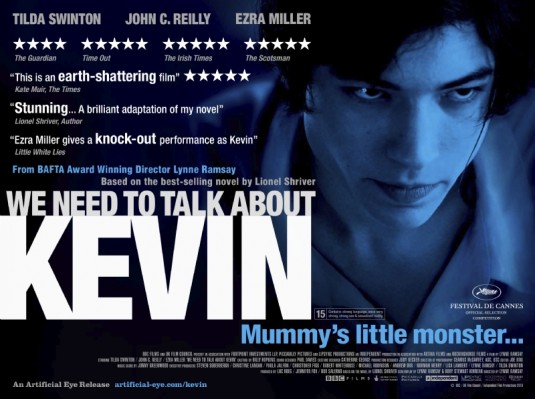
A powerful and terrifyingly chilling entry in the annals of bad seed cinema, We Need to Talk About Kevin is based on Lionel Shriver’s novel, and is so good, that it got Shriver’s seal of approval, as evidenced on the UK quad above.
With a painfully exquisite performance by Tilda Swinton (who was nominated for a Golden Globe for the role, but snubbed by Oscar) as Eva Khatchadourian, and an appropriately “f*cker’s so smug you wanna just slap him silly” turn by Ezra Miller as her fundamentally disturbed son, the eponymous Kevin, We Need to Talk About Kevin is a grim depiction (made even more harrowing by its non-linear narrative structure) of just how wrong raising a child can turn out, and how the ultimately selfish acts of willful and unmindful children impact and reflect on the adults in their vicinity.


Parting shot: Though I love the devil baby OS above, I feel I need to stress that, like Joshua, there is nothing remotely supernatural about the situation in We Need to Talk About Kevin, which, of course, makes it all the more disturbing.

(We Need to Talk About Kevin OS’ and UK quad courtesy of impawards.com.)

Monday, July 2, 2012


¡Qué horror! 2012
Candidate # 19

WE NEED TO TALK ABOUT KEVIN
(May 2011)


Care for a double bill that can potentially work far better than rubbers or the pill to effect birth control?
Try pairing past ¡Qué Horror! title, George Ratliff’s Joshua, with Lynne Ramsay’s We Need to Talk About Kevin.


A powerful and terrifyingly chilling entry in the annals of bad seed cinema, We Need to Talk About Kevin is based on Lionel Shriver’s novel, and is so good, that it got Shriver’s seal of approval, as evidenced on the UK quad above.
With a painfully exquisite performance by Tilda Swinton (who was nominated for a Golden Globe for the role, but snubbed by Oscar) as Eva Khatchadourian, and an appropriately “f*cker’s so smug you wanna just slap him silly” turn by Ezra Miller as her fundamentally disturbed son, the eponymous Kevin, We Need to Talk About Kevin is a grim depiction (made even more harrowing by its non-linear narrative structure) of just how wrong raising a child can turn out, and how the ultimately selfish acts of willful and unmindful children impact and reflect on the adults in their vicinity.


Parting shot: Though I love the devil baby OS above, I feel I need to stress that, like Joshua, there is nothing remotely supernatural about the situation in We Need to Talk About Kevin, which, of course, makes it all the more disturbing.

(We Need to Talk About Kevin OS’ and UK quad courtesy of impawards.com.)

Monday, October 20, 2008


A Rundown of the 13 Best, Most Recent Horror Movies I’ve Seen
[2 of 13]
JOSHUA (January 2007)


… if you like your psychological horror undiluted by any modern Hollywood safety standards, Joshua’s the boy to see.

Read the entire review here.

(Joshua OS courtesy of impawards.com.)

Thursday, April 10, 2008


JOSHUA
(Review)

George Ratliff’s Joshua is a measured and terribly assured psychological thriller that follows Brad and Abby Cairn and their son Joshua, as their lives transform overnight with the birth of the couple’s second child, Lily.
Ratliff’s script, co-written with David Gilbert, takes a realistic approach to the idea of the bad seed and becomes the solid foundation to what is perhaps the most unnerving entry of this lot, which includes films like The Omen, The Good Son, and of course, The Bad Seed.
And not only are Sam Rockwell and Vera Farmiga exceedingly effective as the Cairns, but young Jacob Kogan as the nine-year old Joshua is a fantastic find.
Practically from the get-go, there is an alien otherness to his Joshua, some element in his performance that never once makes you forget that there is simply something wrong with this child.
Rockwell is the father who tries gamely to hold his family, his marriage, and his job together, while Farmiga (who already held her own with some formidable co-stars in Martin Scorsese’s The Departed) is the mother who struggles to keep her head above the treacherous waters of post-partum depression. Their performances and that particular plot point ground the film in a very real and tangible way, which makes things all the more tragic when the narrative takes its turns into “Good Heavens, what an evil child” territory.


Joshua is a chilling look at the changes that are wrought by the arrival of a new child into an already established household. It’s also a disturbing study of just how alien and removed a child can be from its parent.
Though we never get to see what life was like before Lily (the film basically opens with her birth), we do get a sense of how the new infant has managed to encroach on Joshua’s territory, and it’s really only in the light of this fresh arrival that the Cairns become acutely aware that their first child isn’t at all like a regular nine-year old.


I’ve mentioned this ‘round these parts before, that I’ve long been fascinated by serial killer cases. Thus, I’m well aware of the early warning signs of a sociopath in the making. (As are most movie-going types these days, I imagine, given the surfeit of serial killer thrillers out there.)
Still, when the beats are done here, there’s a genuinely troubling nature to the occurrences (some on-screen, many off-) that serve to magnify the cold and calculating threat that lies at the heart of Joshua.


Making quite a stir when it screened at Sundance last year, Joshua didn’t make a whole lot of money in its theatrical release, and I can sort of see why.
It isn’t a comforting film, Joshua. It’s disturbing in a far more insidious way than a movie like, say, The Omen. Stripped of any supernatural horror movie conventions, Joshua’s terrors play as frighteningly real and actually possible; we can’t all be the parents of the AntiChrist, right? But an intelligent sociopath is far more commonplace.
Joshua also plays into that fear of course, that you could do your best to raise your child reasonably well, give him everything you think he wants and needs, never lay a violent, abusive finger on him, and he’ll still turn out to be a sick little psycho.


This disturbed me a whole lot more than I thought it would, and that’s mostly on Farmiga and how her performance becomes this really painful journey to watch. There are several moments where you just want to scream irrationally at Rockwell’s character, “Can’t you see there’s something horribly wrong here?! Look at your wife, man!”
This is award-worthy stuff, but sadly, there’s that stigma horror films are unjustly saddled with, so this will join the ranks of Brilliant Performances in Horror Movies That Will Ultimately Be Ignored By Oscar And His Ilk.
If anything though, Joshua points to a dazzling future for Farmiga.


The other aspect of Joshua that simply gets beneath the skin is the final reveal, when the motivation for Joshua’s actions becomes icily clear. It’s certainly been there from the early sections of the film, constantly hovering in the background, and yet when it does rear its ugly head (in a flat-out disturbing rendition of Dave Matthews’ “The Fly”), it comes at you like an avalanche of maggots.

So if you like your psychological horror undiluted by any modern Hollywood safety standards, Joshua’s the boy to see.
Just be prepared, because he has no concept of the term “kid gloves.”


(Joshua OS courtesy of impawards.com; images courtesy of bloody-disgusting.com; DVD cover art courtesy of dvdactive.com.)