Showing posts with label joshua jackson. Show all posts

Thursday, November 13, 2008


FRINGE
Season 1 Episode 3
“The Ghost Network”
Written by David H. Goodman & J.R. Orci
Directed by Frederick E.O. Toye
(WARNING: SPOILERS)

Okay, now this one felt more like an hour of planting plot seeds than anything else.
At its core, we’ve got the titular network, which is how the Pattern is apparently communicating. I didn’t quite catch the sciencespeak, but it’s basically a frequency no one else knows about, and is thus, secret and secure.
But Roy McComb (Zak Orth), one of Walter’s test subjects from way back, now seems to be receiving the communications, but in images, “visions” he thinks may be coming from God (or the Devil).


The meat of the episode though, seems to be all the teeny bits scattered throughout the hour:
Someone knows Peter is back in the States and is keeping track of him (whether or not it’s those people he owes money to remains to be seen);
We see, in one of those clandestine X-Files–ish meetings, that Broyles and Sharp seem to (proverbially) be in bed together when it suits their purposes, as Broyles hands some key evidence from the case over into Sharp’s cybernetic hand; they also get into some catty verbal sparring over Agent Dunham;
There’s a fleeting mention of Mrs. Bishop, and Peter says, of his mother, “that’s a story for another time”;
And apparently, Mark Valley has a cushy deal going on right now, as Agent Scott’s body (supposedly already deceased at Pilot’s end) is shown hooked up to some Massive Dynamic thingamabob, and they seem to be extracting data from his corpse; for this, he gets a special “With” credit, appearing right before John Noble…

Still, this one’s got some goodies…
Charlie’s shocking revelation at John’s funeral, Walter’s self-medication, and his blueberry pancakes.
Orth’s portrayal of the beleaguered McComb is also a highlight, which kind of makes up for the thinness of the plot.
So, not brilliant, but we are moving forward, and that’s always a good thing.
Let’s hope next episode is chockful of meaty, weird narrative…


(Images courtesy of impawards.com [Fringe OS, design by FOX IN], buddytv.com, and fringetelevision.com.)

Tuesday, October 28, 2008


FRINGE
Season 1 Episode 2
“The Same Old Story”
Written by Jeff Pinkner & J.J. Abrams & Alex Kurtzman & Roberto Orci
Directed by Paul Edwards
(WARNING: SPOILERS)


“Massive Dynamic is one of the ten largest economic entities in the world. Our weapons technologies shape the Defense Department’s strategies. Our investments sway the markets and make or break presidential elections. Overseas, we have responsibilities traditionally sacred to the state: the right to direct private armies, to manage global affairs into stable equilibrium.”


Now, while a certain amount of fun was had with the short-lived Threshold, if there’s a show that’s to be crowned a successor to the late, great X-Files, it’s quickly looking to be Fringe, as it continues to display an excellent mix of speculative science and creepy horror.
And, as if to solidify that X-Files connection, X-alum Darin Morgan clambers on board as consulting producer on Fringe, which makes me a happy camper and even more eager to see what future episodes hold.

The episode’s main plot involves a serial killer/government super soldier mash-up, and writers Abrams, Kurtzman, Orci, and Alias and Lost alum Jeff Pinkner (also one of the show’s producers now) open the hour with a cracking prologue that recalls everything from Humanoids From The Deep to It’s Alive.
Of course, it really isn’t some killer mutant baby that gets born, but the horror movie echoes were welcome nonetheless. (I could have done without the subsequent Aliens–ish nightmare sequence though.)
We also get some fodder for the show’s main throughline (apparently, both Broyles and Massive Dynamic’s Nina Sharp are on a committee concerned with investigating the Pattern; this shadow cabinet, another bit that recalls The X-Files) as well as an intriguing allusion to Peter’s “medical history.”
Oh, and apparently, Dunham and company are a “new team,” and there’s a passing mention of a previous team. Hurm…


Anna Torv continues to impress, as does John Noble, who again, is the show’s MVP, nailing the script’s primo stuff (the seat warmer bit is hilarious) with apparent and enviable ease.
Joshua Jackson however, is still a tad shaky. Why a genius with an IQ of 190 (a fact repeated in this episode) would resort to using the term “magic old man baby” is a little beyond me… He just can’t seem to shake the ghost of Pacey.
At any rate, this one’s a winner and strengthens Fringe’s credentials as one of this season’s triumphs.
Bring on next week’s weirdness!


(Images courtesy of impawards.com [Fringe OS, design by FOX IN], variety.com, buddytv.com, and fringetelevision.com.)

Monday, October 6, 2008


FRINGE
Season 1 Episode 1
Pilot
Written by J.J. Abrams & Alex Kurtzman & Roberto Orci
Directed by Alex Graves
(WARNING: SPOILERS)


When Fringe was first announced by the trades, I had a number of reservations:
One: though J.J. Abrams’ name was attached, I can’t say I love everything he’s worked on.
If you’ve visited the Iguana before, you may know that I’m a big Lost fan, and I was also a fan of Felicity. And Cloverfield was brilliant.
But I never got into Alias, and I wasn’t that thrilled with Mission: Impossible III either.
Two: the other writer/producers announced were Roberto Orci and Alex Kurtzman, whose scripts for M:i:III and Transformers didn’t inspire much confidence.
Three: the supreme hurdle for the show, as far as I was concerned—the premise sounded terribly X-Files-ish.

So how could the show get out from under that daunting shadow? And could the Pilot, at the very least, win this X-phile over?
I think I’d have to say the answer is a qualified “Yes.”


First off, the Pilot has a very effective pace, keeping the narrative engine going at a fast clip, while allowing time for involving character bits.
We have FBI Special Agent Olivia Dunham (Australian actress Anna Torv), whose very personal stake in the preliminary case is telegraphed well, her desperation and anxiety palpable without being overpowering.
Then there are the father and son issues between underachieving genius (IQ 190) Peter Bishop (Dawson’s Creek’s Joshua Jackson) and his mentally unstable father Walter (played most excellently by mad King Denethor himself, John Noble, incidentally also Australian).
Oh, and the case—which will require the expertise of the elder Bishop, institutionalized nearly two decades ago, and the younger Bishop, who must serve as his father’s guardian—involves the very messy deaths of all the passengers and crew on an international flight which lands at Boston’s Logan Airport on auto pilot. (I was hoping it would be an Oceanic flight, but alas, no such luck…)

Is there, perhaps, a smidgen of convenience in the speed at which matters are expedited on the Pilot? Maybe.
But I’ll let it slide, as it is, quite literally, a life-or-death situation, and the fact remains that the Pilot never drags, and it’s a great opener that’s got the thrills, the laughs, and the requisite Abrams air of mystery to make it eminently watchable.


Clearly, this is the first Orci-Kurtzman script that’s kept me attentive and absorbed, and all involved lucked out with their casting of Noble as the certified (and certifiable) genius.
Noble delivers a portrait of tragic intelligence, laced with an unnerving air of potential lunacy, the kind of brilliance fueled by an unfettered mind. And what is more freeing, after all, than insanity?
Plus, Walter gets the best lines, and Noble delivers them with a grand, understated flourish. (The LSD bit is priceless.)

If there’s anyone in the cast who still hasn’t completely won me over by the Pilot’s end, it’s Jackson, who, unlike Noble, doesn’t quite emanate “genius” (unstable or otherwise) from his acting pores. Sorry, but at the moment, Peter just doesn’t seem to scream “190 IQ.”
We’ll see though. Still early in the game…


Getting back to the pluses, the mystery throughline for the show—“the Pattern”—is introduced effectively in the Pilot, a hook which is central to Fringe’s viral marketing, complete with the show’s catchphrase: Find the Pattern.
There’s also a megacorporation—Massive Dynamic (“Your World Is Our World.”)—that figures into the narrative goings-on, has a connection to the elder Bishop’s past, and whose motivations are, to say the least, shadowy.
Oh, and their equivalent of the on-screen text to establish setting (ala X-Files) is a neat visual which takes a page from Heroes’ chapter titles. (I particularly love the bit in Iraq.)

Now, all indications seem to point to the show being more episodic, as opposed to the heavily serialized nature of Lost.
Given though that there is “the Pattern” to contend with, I imagine Fringe may follow the lead of—and yet again, the comparison arises—The X-Files, which was largely episodic in nature, with the mythology episodes popping up over the course of its run.
Or, perhaps the template here will be more akin to Alias, as I can’t imagine Fringe will have out-and-out comedic episodes as The X-Files did.


Regardless, the show owes much to Chris Carter’s pioneering work, as well as all the test driving the post-X-Files shows of this stripe managed over the intervening years.
While it understandably took stretches of The X-Files’ freshman season for all involved to work the kinks out of the show (after all, there wasn’t really any precedent as far as the kind of series it was aiming to be), the Fringe Pilot is pretty much a fully-formed, ably constructed entity.
Not as audaciously slap-in-the-face as, say, the Lost Pilot, or, going back further, Twin Peaks’ opening salvo, mind, but effective and involving nonetheless.

So consider me hopeful and strapped in for the ride, though I will admit to still having some reservations about the upcoming experience.
Colour me cautiously optimistic over this one.


(Images courtesy of impawards.com [Fringe OS, design by FOX IN], latimes.com, tvweek.com, fringetv.blogspot.com, and fringetelevision.com.)
Friday, July 11, 2008


SHUTTER (2008)
(Review)

Before we get to the main attraction, I feel that going over my review for the original Shutter (contained in the Archive), would better illuminate some of the comments I’ll be making about the English-language redux.
So, if you haven’t yet read it, it’s the first entry in the Iguana’s irregular series, “In The Interests of All Things Recyclable.”
And if you’ve already read it…


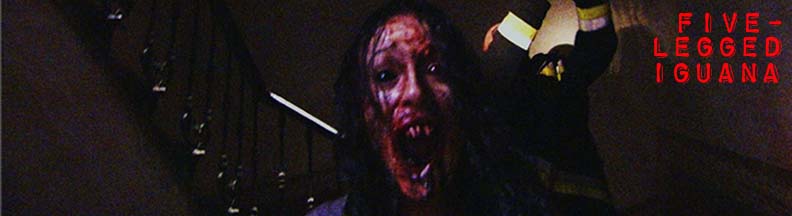
Benjamin Shaw (Dawson’s Creek’s Joshua Jackson, soon to be seen on J.J. Abrams’ latest TV salvo, the much anticipated Fringe) and his brand new wife Jane (Transformers’ Rachael Taylor) are honeymooning in Japan, when an apparent accident kicks off the supernatural goings-on of the film, occurrences which springboard from the spectral trappings of the world of spirit photography.
As early as the initial set-up, the remake takes the original’s basic premise, and executes its own alterations in an attempt to improve upon Banjong Pisanthanakun and Parkpoom Wongpoom’s effort.

Fortunately, this outing actually improves upon the problematic characters found in the original. Here, the male lead comes across as a far more sympathetic character when it counts, keeping the audience suitably occupied and interested, and perhaps more crucially, the female lead is actually written as a definable entity, as opposed to the plot appendage she seems to be in the original.
Jackson and Taylor also submit serviceable, if not particularly distinguished performances, thus making the proceedings passably engaging.
However, while the choice of making the Jane character a more pro-active force in the narrative reinforces the whole, that improvement seems to remain a largely theoretical victory.


The problem, I feel, still remains that, as with the original, this Shutter’s script (by Luke Dawson) isn’t the tight, tense little animal it should be. And the scares—again, as with its Thai progenitor—aren’t as potent as I’d hoped they would be.
Having said that though—and despite the fact that some of the original’s scares are far more noteworthy than their equivalents here—this is, I believe, the first time where a case can be made to argue that the English-language remake plays better than the Asian horror original.
Yes, it’s still a sometimes stuttering affair, but the characters and central mystery depicted here are more plausible and make more narrative sense than those in the original.
And not only is it better than director Masayuki Ochiai’s previous efforts, Parasaito Ivu (Parasite Eve) and Kansen (Infection), it’s also better than this year’s other Asian horror reduxes, Eric Vallete‘s One Missed Call and David Moreau and Xavier Palud’s The Eye.

Ultimately, Ochiai’s Shutter is an intermittently effective horror film that, perhaps, would have played better for me if I was unfamiliar with the original.
Still, it’s a fairly enjoyable ride, and there are far worse out there (like Vallete’s One Missed Call).
So, give it a (heh) shot, if you’re so inclined.

Parting shot: Reviews of the original Shutter, the English-language remakes of One Missed Call and The Eye, as well as Transformers and Cursed (in which Jackson also appeared), can be found in the Archive.

(Shutter OS courtesy of joblo.com; images courtesy of filmz.ru.)

Tuesday, July 3, 2007


reVIEW (6)
CURSED

Spurred by Wes Craven’s recent turn as a guest judge on On The Lot, I thought to resurrect this review of Cursed (a review which began life answering to the name, “Bad Moon Rising”; go ahead, you can call it that. I’m sure it won’t mind).

Saddled with such a sadly appropriate title, it’s a small wonder that Cursed actually got completed and managed to lope its way into theatres. Of course, once you get to see it, you may just wish it had been shot in the head with a silver bullet while it was still unfinished.
Brought to you by the Scream team, director Wes Craven and writer Kevin Williamson, Cursed has had a tortured existence, laboring under its own version of the Mark of the Beast: delays, rewrites, and re-shoots.
Apparently, much like Exorcist: The Beginning, Cursed was practically re-shot in its entirety, much of the original cast (who were no longer available due to other film commitments) replaced, for the version unleashed upon us hapless movie-goers. Reportedly, one of the major changes was shifting it from an R-rating to a PG-13, effectively neutering whatever bite it may have initially had.

Ostensibly, the film is a horror thriller which purports to show us the travails of brother and sister Jimmy (Jesse Eisenberg) and Ellie (Christina Ricci), who’ve both been infected by a werewolf. In actuality, it’s a flat and tiresome experience that is a definite low point for both Craven and Williamson.
Not that either is a stranger to low points, mind you. Since making an impact with the infamous The Last House on the Left in 1972, Craven‘s career has been checkered with soaring highs (A Nightmare on Elm Street, Scream/Scream 2) and abysmal lows (Deadly Friend). Williamson, meanwhile, exploded onto the scene with Scream, and delivered a brilliant sequel in Scream 2, but spiraled ever downwards, passing on the way to the bottom such disappointing sights as The Faculty, Dawson’s Creek, the again appropriately-titled Wasteland, and the horrific (in the worst sense of the word) Teaching Mrs. Tingle.
So… low points? These gentlemen both know low points. I suppose I was just holding out the hope that whatever elusive spark, whatever strange alchemy they managed to tap into with Scream and Scream 2, they would find a third time.
No such luck.
It’s almost as if both suddenly developed creative amnesia, and whatever they seemed to know about suspense and horror, on display so elegantly in the first two Scream installments, evaporated into thin air.

Nowhere in the entire running time of Cursed do we find even a smidgen of the taut suspense Craven and Williamson managed to pack into Scream’s now-familiar opening sequence involving Drew Barrymore, a phone, and some popcorn. What we have here is 96 minutes of ho-hum that isn’t even remotely entertaining.
And since Ellie and Jimmy need to kill the werewolf who is the source of the infection in order to return to normality, it actually gets to a point where you start praying for a RAW Smackdown with Real Actual Werewolves just slapping each other around in some mindless popcorn horror fashion, just to ease the tedium. Tragically, even that doesn’t come to pass.
Like I said. Ho-hum.

And anyone who’s seen Scream will tag Cursed’s opening for what it is: a sequence which introduces us to cannon fodder, in this case, American Pie’s Shannon Elizabeth and singer Mya, the former delivering a particularly hilarious performance as Becky, the werewolf’s first on-screen victim.
Hijacked for the miserable ride are Dawson’s Creek’s Pacey, Joshua Jackson, Smallville’s Lex, Michael Rosenbaum, Gilmore Girls’ Jess, Milo Ventimiglia, Judy Greer (Jawbreaker, The Village), and Scott Baio—playing himself (!) in an ultimately pointless subplot—presumably to pad the suspect list with a gaggle of red herrings, in a vain attempt to confuse the issue, never once fooling us as to the identity of the mystery master werewolf.
It should be noted at this point that in the process of the unmasking, there is a rupture in the film’s logic (or perhaps it was just me slipping into semi-catatonia for a few seconds, thus missing a vital plot point—though I doubt it), not that that’s such a big deal, considering logic is seemingly just as much of a rarity in Cursed as actual thrills.

The thing is, the field was wide open with werewolf films. I certainly wasn’t expecting another An American Werewolf in London, John Landis’ ultimate word in werewolf cinema, but they could have tried. They could have made some kind of positive mark. As it is, Cursed could have fallen smack dab in the middle of Howling II: Your Sister is a Werewolf and the seventh installment of this sad and sorry franchise, Howling: New Moon Rising, and I wouldn’t have blinked an eye.

The saddest part, I suppose, is that this terrible miscarriage masquerading as a movie was the result of the collaboration of two individuals who know the game: these aren’t neophytes here, not even sophomores. These are individuals with Masters at horror*, and yet managed to produce not a sleek, sly, and cunning beast, but a whining, mangy cur with its legs all wobbly, its tail between its legs, and its teeth all fallen out.

* Well, maybe in Williamson’s case, a Magna Cum Laude.

Parting shot: Ventimiglia has, of course, gone on to the phenomenal Heroes. (You can tell this is an old review, as I didn’t describe him as “Heroes’ Peter.”)

(Cursed OS courtesy of impawards.com.)

Wednesday, June 13, 2007


IN THE INTERESTS OF ALL THINGS RECYCLABLE (1)

Given Hollywood’s sometimes annoying penchant for the redux, I’m starting this irregular series wherein I’ll be doing two things: either go back and re-watch a film I haven’t seen in a while and finally write a review for it, or, in the case of films I’ve already written reviews for, exhume said reviews, touch them up for public viewing, then have them zombie-toddle onto the world wide web, where they shall hopefully entertain and enlighten, as they were always meant to do.
These reviews will, of course, be of films that have remakes headed towards a multiplex near you.
And first up, Shutter

Looking back…

SHUTTER

In the still-burgeoning Asian horror scene, Thailand is best known for having produced the Pang Brothers, who gave us Gin Gwai (The Eye) and its sequel, as well as Bangkok Haunted.
There are, however, other Thai directors who have also contributed to the movement, such as Nonzee Nimibutr, who brought us Jan Dara, as well as the “The Wheel“ segment of the pan-Asian horror anthology, San Geng (Three).
And then there are Banjong Pisanthanakun and Parkpoom Wongpoom, with Shutter.

Photographer Tun (Ananda Everingham), along with his girlfriend Jane (Natthaweeranuch Thongmee), is coming from the reception of a just-married friend, when an apparent accident kicks off the supernatural happenings of the film. Cue the by-now standard long-haired female ghost of the genre, and Shutter goes into full swing.
One of the film’s shortcomings though, is that it doesn’t swing quite as much as one would hope. Though Shutter is pretty evenly-paced, that pace may be a bit too leisurely for its own good. A sense of tension and danger is traded in for a steady, measured creep that falls short of weaving the veil of atmosphere and dread you’re fully expecting it to build up to.
Instead, Shutter seems more interested in wrangling what it can out of its central conceit of spirit photography, than paying closer attention to its story and that story’s pacing. Though the old flip book trick with the photographs is still utilized with creepy effectiveness here, and Tun with the Polaroid towards film’s end is a nice tense sequence with a nifty and macabre pay-off, the other photo-related scares are rather run-of-the-mill.

What cripples Shutter even more is the fact that Tun doesn’t come across as a sympathetic character, and the penultimate reveal makes him even less so. Jane is pretty much a cipher as well, content to play the role of concerned girlfriend caught up in the story’s events simply by association.
Presented thus with characters who aren’t readily identifiable and engaging, the audience is left in the position of impartial observer, like the photographer behind the lens, waiting for just the precise moment when all the elements feel right, and the instant is one worthy of posterity. Sadly, that moment never comes, and we’re left with our thumb hovering over the button, unsatisfied and vaguely annoyed.
Thus, with that buffer between the audience and the story, most of the scares feel filtered and muted. The fact that many of them are old hat doesn’t help either.

The film’s pace and Tun’s likeability as a character are assaulted even further by the decision to leave a chunk of the supernatural goings-on (those not occurring directly to either Tun or Jane) off-screen. When Tun discovers what the ghost has been up to beyond his (and the audience’s) purview, it only serves to make him seem painfully self-involved, making the viewer ask himself, What kind of a friend and person is Tun, really? A question answered towards film’s end, sounding the death knell for whatever little sympathy we may have managed to scrape together for poor Tun.
Ultimately, Shutter isn’t horrible nor is it unwatchable. It just doesn’t rise very much from the merely passable. And though that is better than being pedestrian and mundane, it doesn’t quite cut it in the veritable monsoon of Asian horror films that continues to flood multiplexes from Hong Kong to Tokyo, from Seoul to Bangkok to Manila.

“They are around us,” or so the tagline for Shutter claims, referring of course, to ghosts. But in this day and age, they may as well be talking about Asian horror films. Shoulder to shoulder, their ghosts stand, features obscured by the ebony fall of their long, dark hair. The homogeneity must be broken though, the hair pulled back from the wraiths’ faces, that we may appreciate them in their particularity, rather than the gradually-blurring collective they are becoming, the group picture of them that is losing its color and detail, as the months and years go by.

Since then…

The directing tandem of Pisanthanakun and Wongpoom saw the release of their follow-up horror effort, Faet (Alone), this past March in Thailand.
Haven’t been able to see that one yet, though I am curious…

Looking forward…

The English-language remake has its setting moved to Japan, with Rachel Taylor and Joshua Jackson as the young couple in peril. Taylor can be seen in the WWE horror movie See No Evil, and in the upcoming Transformers, while Jackson is of course, best known as Pacey from the Creek, and has appeared in past horror movies, the so-so Urban Legend and the appropriately titled Cursed.
Also in the remake are Ando himself, James Kyson Lee, Roy from the US redux of The Office, David Denham, and Matt from Nip/Tuck, John Hensley.
It’s directed by Masayuki Ochiai, who gave us Parasaito Ivu (Parasite Eve) and Kansen (Infection), neither of which I was terribly impressed by, but I do hope Ochiai manages to improve on the original, particularly in the lead character department.

(The Shutter review began life under the title, “Out of Focus.”)

(Shutter OS courtesy of papigiulio.com)