Showing posts with label eco-horror. Show all posts

Thursday, January 6, 2022

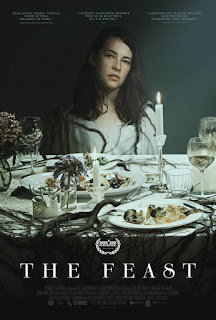
GWLEĐĐ (THE FEAST) (March 2021)


GWLEĐĐ 
(THE FEAST)
(March 2021)

You'd better watch out,
Walking down the street,
Seeing your curly head of hair…
 
You wake with a smile
From a beautiful sleep,
King of the crows
With your lively eyes…
 
Oh, my sweet,
You’d better watch out.”
 
Having previously worked on TV series such as Doctor Who, director Lee Haven Jones makes the transition to feature films with the exquisitely savage Gwleđđ (The Feast).
Scripted by Roger Williams (who likewise cut his teeth in television), the Welsh-language Gwleđđ follows Member of Parliament Gwyn (Julian Lewis Jones) and his family over the course of a single day, as they host an ill-fated dinner.
 
Initially a languid affair, Gwleđđ’s unnerving atmosphere gradually builds towards a gory, blood-spattered final stretch, as we bear witness to the revenge nature takes on the depredations of men, who are only too willing to exploit and plunder and “think of new ways for you to make money,” at the expense of the delicate balance kept with ancient forces tied to the land.
 
Dyw hi ddim fod cael ei deffro.
(“She musn’t be awakened.”)
 
One of the blurbs on the one-sheet refers to Gwleđđ as “folk horror,” and it is, in spirit if not in overall aesthetic.
Our main setting is Gwyn’s home, built on farmland owned by the family of Gwyn’s wife, Glenda (Nia Roberts), a local girl done good, who now seems embarrassed of her roots. (At one point, she dismisses the things left to her by her mother as “primitive,” sorely out of place in her modern home.)
It’s this push-and-pull between the old and the new, the traditional and the cosmopolitan, that serves as one of the main pillars upon which Gwleđđ rests.
 
Don’t let the initial, apparently slow-going fool you.
Eventually, Gwleđđ raises its head to reveal its bloody mouth and the bits of gristle caught between its teeth, and it is quite the terrible, glorious sight to behold.
 
Ar ôl i ti gymryd popeth, beth fydd yn weddill?
(“After you’ve taken everything, what will be left?”)
 
(The Feast OS courtesy of bloody-disgusting.com.)

Saturday, November 3, 2012


¡Qué horror! 2013
Candidate # 4

THE BAY
(September 2012)


“My name is Donna Thompson. For three years, I and a few others have been trying to speak out about what happened in Claridge, Maryland, on July Fourth, 2009. But sometimes, words have no impact.
“But now, with the help of a website called govleaks.org, all of the digital information that was recorded that day has been obtained. All of the digital information that was confiscated.
“Now, I don’t know if anyone is gonna be watching this. I don’t know if anything is gonna happen to me as a result of me putting this out there, but I do know that I… can’t move on with my life until this story is told.”

I love Barry Levinson for having given me both Diner and Wag the Dog. He’s also brought us Rain Man, Good Morning, Vietnam, Bugsy, and The Natural, to name just a few more.
So when news broke that he was doing a horror film titled Isopod, I knew I needed to pay attention. And I kept track of this baby, watching its title morph into The Bay, all the while wondering whether Levinson could deliver the scares.
Now, the closest Levinson ever came to the weird sh!t in the past was probably Sphere, and that was certainly not a horror film. Or at least, not a horror film in the way The Bay most certainly is.

Born in Baltimore, Maryland, Levinson was asked if he was interested in doing a documentary about the “40% dead” Chesapeake Bay.
But after realizing there were already well-made documentaries on the subject, Levinson instead took the scientific facts and placed them in a fictional context. With the help of writer Michael Wallach, what came of this creative choice, is the wildly disturbing ecological horror of The Bay.

“The term now is ‘found footage’ but it never occurred to me. I wasn't thinking that way, I guess.  I thought, if something catastrophic like this happened in a small town and there was no media, what was going on?  Then you say, this is the first generation that records every intimate moment.  They've got cell phones, they text, email, Skype and this is the very first time you get an intimate look at the people, basically, at the core of where a catastrophe is going on around them.  I thought it was a cool idea--I could tell multiple stories and a lot of people won't have an overview because they don't know what's going on.  So, that was kind of scary, too.” *

Told across a broad spectrum of today’s varied means of communication--Skype, FaceTime, cell phones, email, text messages--as well as through video and audio recordings, The Bay has elements of both the found footage and viral outbreak genres, but in the end, isn’t really either.
In the end, what Levinson and company have given us is a terribly effective chiller with one of the ookiest parasites ever brought to the screen, a parasite that just happens to actually exist in real life.
Sure, Levinson’s isopod is a mutated version of the real thing, but still, they do occur in nature, so you really gotta wonder…

Hands-down the freakiest and most viscerally disturbing of the ¡Q horror! 2013 candidates thus far, The Bay is a gruesomely welcome surprise from the 70-year old Levinson, and a solid piece that should nestle comfortably with its fellow eco-horror titles.

* Barry Levinson, from an interview with shocktillyoudrop.com

(The Bay OS courtesy of impawards.com)

Sunday, December 6, 2009


LONG WEEKEND
(Review)


I made mention of an eco-horror double feature comprised of Larry Fessenden’s The Last Winter and Davis Guggenheim’s An Inconvenient Truth in my review of Fessenden’s film (which slumbers in the Archive).
Now, I’ve found a film I can wholeheartedly place alongside that pair for a chilling eco-horror troika.
That would be Jamie Blanks’ remake of Long Weekend.*


Though I’ve yet to have the opportunity to see Colin Eggleston’s 1978 original, Blanks’ redo sticks to the premise of a couple on a weekend getaway, who find themselves at the cruel mercies of nature. (The remake is still written by Everett De Roche, who penned the original and who had worked with Blanks previously on Storm Warning.)
This time out, it’s Jim Caviezel and Claudia Karvan (soon to be seen in the upcoming Spierig Brothers’ Daybreakers) as Peter and Carla, a married couple whose relationship is clearly in dire straits when we join them as they prepare for the eponymous getaway.
The bitterness and recrimination is so palpable, even when it’s submerged, you can’t help but wonder what they saw in each other in the first place. There must have been love at some point; they’ve got the wedding bands to prove it, after all. You just can’t really see it these days.
And by the time the reasons for their estrangement are revealed to us, not only is it too late for their marriage, it’s quite possibly also too late for their lives as well.


Even as it chronicles the final death throes of a relationship gone horribly toxic, the film also shows in no uncertain terms, the callousness and presumption with which we, as a species, treat our planet.
The fact that Peter is a “self-centred prick” (as Carla calls him at one point in the film)—or, as I prefer to think of it, just a plain old flaming a$hole—is cold comfort when his actions (and Carla’s as well, for that matter) probably happen every single day, in some part of the world.
It’s interesting to note that these actions come from two different places. In Peter’s case, they’re done out of complete disregard for anything else other than himself. In Carla’s case, it’s out of an innate dislike and distrust of the outdoors.
It’s always a telling point to observe a person once they’re taken out of the confines and comfort of civilization and made to rough it. That’s when you can tell the stuff a person’s really made of.


I should stress at this point that this is not an “animals attack” sort of film (though there is that in the mix; and one must never forget that De Roche also scripted the “giant pig in the Outback” extravaganza that was Russell Mulcahy’s Razorback); Blanks’ Long Weekend is more about mood and atmosphere and good old fashioned creepiness.
In fact, aside from that eco-horror troika, I will also place Long Weekend squarely beside such venerable titles in the Creepy-a$$ Aussie Film Library as Peter Weir’s Picnic at Hanging Rock and The Last Wave. If anything, Blanks’ remake has made me even more curious to see Eggleston’s original.


Here, Blanks and De Roche focus on the fear of the unknown, of what’s out there, beyond the campfire’s glow and the headlights stabbing off into the deep, primeval night.
It’s about how so many things in our world are plainly beyond our understanding and our control.
At one point in the film, Peter points out to Carla that not everyone is afraid of nature.
Well, if Long Weekend is anything to go by, maybe we should be.
And if “fear” is too strong a word and emotion, then perhaps a healthy sense of respect will do.
Given the current state of our planet, it’s long overdue.

* In the U.S., Long Weekend has been retitled Nature’s Grave, as evidenced by the rather horrid DVD cover art below.


Parting shot: In the interests of full disclosure, there are a couple of skeletons in Blanks’ cinematic closet.
Primarily, there’s Valentine, and to a lesser extent, Urban Legend.
Urban Legend had a couple of passably effective sequences, but as a whole, wasn’t really that distinguished a title. Valentine, on the other hand, was just plain dreadful.
Though I’ve yet to see Storm Warning (which I understand may well be worth a look), I can safely say Long Weekend clears Blanks’ slate of its past blemishes.

(Long Weekend OS courtesy of impawards.com; Nature’s Grave DVD cover art courtesy of shocktillyoudrop.com; some images courtesy of outnow.ch.)

Friday, November 6, 2009


THE THAW
(Review)


“The melting Arctic will reveal a frightening truth.”

In the ecological horror film The Thaw, director Mark A. Lewis presents us with a prehistoric parasitic terror that could prove to be the end of all there is. (Or, at the very least, put a very serious dent in civilization as we know it.)
The apocalypse cinema conceit is established right off the bat with the news montage-as-opening credits sequence gambit done in such entries as Zack Snyder’s Dawn of the Dead redux, Danny Boyle’s 28 Days Later, and Logan McMillan’s Last of the Living.
The gambit worked in those films, as it does here.
Of course, the reality is, as early as its opening credits sequence, The Thaw is already recalling earlier horror films, and it continues to do so, as the reels unwind…


Set on Banks Island, in the Canadian Arctic, the film brings to mind John Carpenter’s The Thing, the first season X-Files episode, “Ice” (which was, itself, a sort-of, kind-of Thing retread), Carter Smith’s adaptation of The Ruins, and the brilliant eco-horror entry, Larry Fessenden’s The Last Winter.
Which is, frankly, rather august company, if not for the fact that The Thaw suffers in comparison.
Having said that though, I must stress that The Thaw is still worth your time. I mean, when you’ve got X-Files alumnus William B. Davis in the aforementioned opening credits, talking about global warming and Armageddon and how it’s all our damned fault, well, that’s something that you need to pay attention to.


I have to say though, that aside from the semi-familiarity of the material, the cast isn’t exactly across-the-board good either.
There’s Val Kilmer in there (as ex-eco-activist David Kruipen) and Smallville’s Aaron Ashmore (whose twin Shawn happens to have been in The Ruins) and Everything’s Gone Green’s Steph Song, who’s saddled with a rather thankless role here.
There’s also Martha MacIsaac (as Kruipen’s mightily pissed-off daughter, Evelyn) and Kyle Schmid (from TV’s Blood Ties).
I shall refrain from pointing out which of the above are the weak links in the film’s cast… (Though I will say that MacIsaac did a great job in Dennis Iliadis’ remake of The Last House on the Left.)


Still, with all its flaws, The Thaw does have a bunch of cringe- and shudder-inducing moments, and, like The Last Winter, can serve as an effective cautionary tale of how we, as a race inclined to apathy, and perpetually unsatisfied with our lot, may very well end up destroying ourselves.
If you’ve been avoiding Davis Guggenheim’s An Inconvenient Truth thus far because “documentary” is still a dirty word to you, then perhaps The Thaw is the answer.
I mean, if a teeny Ice Age parasite can help wake up the masses, I’m sure Al Gore wouldn’t mind…


Parting shot: Reviews of The Last Winter, The Ruins, The Last House on the Left, and Everything’s Gone Green can be found in the Archive.

(The Thaw DVD cover art and images courtesy of shocktillyoudrop.com.)

Sunday, October 19, 2008


I did this first quite a while back, compiled a list of the best and most recent horror movies I’d seen. I always meant to do it again, on a regular basis, but never quite got around to it.
Now though, I’d like to change that.

To commemorate Halloween ’08, here’s a baker’s dozen of the most effective horror titles in recent years, one a day, till we get to October 31.
Note that since what’s key here is most recent, this is in no way a countdown towards the best contemporary horror movie. As we get closer to Halloween, we’ll just be moving forward in time, till we reach the most recent noteworthy horror film I’ve had the opportunity to see and review here at the Iguana. (Dates indicated are the film’s official premiere, as per imdb.com.)

I should also point out that I’ve yet to see some key foreign language horror entries that have generated a fair amount of buzz in the past months, including Jaume Balaguero and Paco Plaza’s [REC], Tomas Alfredson‘s Lat den ratte komma in (Let The Right One In), and Ole Bornedal’s Vikaren (The Substitute).
It’s entirely possible that this list would look a tad different if I had. (At any rate, there’s always next year’s list.)

For now though, here’s #1…


A Rundown of the 13 Best, Most Recent Horror Movies I’ve Seen
[1 of 13]
THE LAST WINTER (September 2006)


The Last Winter (co-written, produced, edited, and directed by Larry Fessenden) is an absorbing piece of environmental horror that paints a sinister portrait of nature turned vicious, as it strikes back at the species that has systematically plundered it for its resources, unmindful of the consequences.

Read the entire review here.

(The Last Winter OS courtesy of impawards.com.)

Wednesday, September 10, 2008


THE LAST WINTER
(Review)

“Alaska, vast wilderness of the north. Land of great natural beauty and diversity. This is rugged country, land of black gold.”
-- North Industries company video

The land is changed... the biosphere turned, become unfamiliar and erratic. I would say vengeful, but nature is indifferent to us. We fight for our survival, not nature’s.
There’s a fierceness in the wind I’ve never felt before—something is being unleashed from the softening permafrost.
-- An excerpt from James Hoffman’s journal


Two decades after a test well was drilled into a section of the Arctic National Wildlife Refuge, North Industries (“Trust. Risk. Results.”) stands poised to begin an earnest push towards erecting drill sites and pipelines, with an eye towards discovering more oil deposits as the U.S. stubbornly marches towards its goal of “energy independence.”
They just need the thumbs up from the “greenies,” environmental experts who can determine whether the move will impact adversely on the land.
But something is happening at the North Industries base camp. Something whose epicenter seems to be that test well. Something that will brutally remind the North Industries team that the human race doesn’t call the shots.


The Last Winter (co-written, produced, edited, and directed by Larry Fessenden) is an absorbing piece of environmental horror that paints a sinister portrait of nature turned vicious, as it strikes back at the species that has systematically plundered it for its resources, unmindful of the consequences.
The struggle between those who would continue to simply take and those who would prefer circumspection is solidified in the persons of company man Ed Pollack (Ron Perlman), who leads the North Industries team, and James Hoffman (James LeGros), one of the two on-site “greenies,” who senses the wrongness in the air, but cannot quite pin it down, initially focused as he is on numbers and measurements.
It’s the tension and debate between these two characters—and the excellent performances by the actors—that anchors The Last Winter, even as the on-screen events serve to unravel the tight community of the North Industries team.


With a premise that contains much of the action within the confines of the base camp, the scenario is one we’ve seen in cinema before, of comrades co-existing in a claustrophobic space, cut off from civilization, in a situation where the stresses are monumental, and the individuals’ mental health is always placed in a questionable light.
It’s the scenario of Ridley Scott’s Alien, Wolfgang Petersen’s Das Boot, or, more to the point, John Carpenter’s The Thing.
The Last Winter is, in fact, the first time since Carpenter’s classic remake that the scenario has been so bloody effective.
Fessenden’s script and steady hand, coupled with G. Magni Ágústsson’s excellent cinematography and the rest of the commendable cast, rams the situation home, not only in the slow and steady build-up, but also in the chilling desperation of the film’s third act.


The atmosphere of tension and uncertainty Fessenden captures, where everything—even the swerving and gliding camerawork of Ágústsson—becomes suspect and worthy of fear, is all-encompassing, a shroud of unease which blankets the audience for a majority of the film’s running time.
Even in the face of M. Night Shyamalan’s The Happening—which engenders its own air of suspense and paranoia in relation to nature’s cruel charms—Fessenden’s achievement in The Last Winter still remains cinema’s most effective environmental creepfest of recent memory (and without Shyamalan’s bad case of miscasting).
It’s this sense of nervous anticipation which permeates The Last Winter—of what could be just around the corner and in the next few minutes of running time—that keeps the film tight and riveting during the deliberately paced first act.


I’d be remiss if I didn’t also make mention of the pair from Friday Night Lights: Connie Britton (who plays Abby Sellers) and Zach Gilford (as the youngest member of the team, Maxwell McKinder, son of Pollack’s close friend).
I may not have gotten into the show, but these two are also a large part of what makes The Last Winter work. There’s a quiet, yet solid strength to Britton’s Abby (who is also simultaneously an ambiguous figure whose true motivations aren’t readily apparent), while Gilford’s Maxwell is the first to twig to the nature of exactly what is out there in the ice and snow—the bit with the camera in the dead of night is a fantastic sequence—his performance largely understated, yet hauntingly effective.


The Last Winter is the kind of horror film I love, the kind that unsettles and disturbs and actually says something in the process.
Yes, there are montages and stock footage that serve to drive Fessenden’s point home, but there are also more subtle and devious bits to keep the audience unbalanced: disquieting shots of bleak fields of ice, the stark whiteness broken by lone objects. Footprints that stop dead in the snow. Scrawled journal pages. A pair of boots, abandoned.
There’s also that damned killer tease of a final shot.
And there’s Tom Laverack’s “Running Out of Road” (with Fessenden on sax and backing vocals), a post-millennial dirge to the planet we’ve systematically destroyed, and the dead end we’re still careening towards; the film’s final grace note, that turns the expertly sustained horror of The Last Winter into a wracking grief for all that we’ve lost, and all that we still stand to lose.

The world we grew up in is changed forever.
There is no way home.
-- An excerpt from James Hoffman’s journal

“I really think that the best horror is derived from real life and the fact is, real life is filled with issues. I don't know if they need to be partisan issues, but they're political and that there are solutions and there's debate as to how to address things.
“In the case of
The Last Winter, we can disagree all we want about how to solve problems, but the problems don't change. They can get worse and worse and you can keep arguing all you want, but the f*cking world can collapse around you. You can do something or not, but the world ain't waiting for us to come up with solutions. It's going to do what it's doing and it's moving in a very scary direction.”
-- Larry Fessenden

Parting shot: A double bill of The Last Winter and Davis Guggenheim’s An Inconvenient Truth should scare the living daylights out of its audience.
Throw The Happening in there and turn everyone into instant Greenpeace members…
Or at the very least, make them check out this section of the world wide web…

(The Last Winter OS courtesy of impawards.com; images courtesy of glasseyepix.com and shocktillyoudrop.com.)