Showing posts with label norway. Show all posts

Friday, July 17, 2009


DØD SNØ
(DEAD SNOW)
(Review)


Norwegian director Tommy Wirkola kicks off Død snø (Dead Snow) to Grieg’s “In the Hall of the Mountain King,” and this rousing (yet vaguely sinister) tune ushers us—without much ado—into this fun Nazi zombie romp.
Yes, you read that right.
Nazi zombie.
How cool is that?!


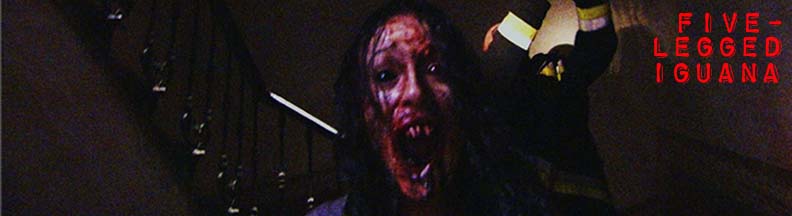
A bunch of med students are off in the snow-capped mountains for Easter vacation, and, well, they run into those pesky Nazi zombies, and much screaming, and bloodshed, and running around (yes, these are post-28 Days Later deadheads) ensue.
Now, despite that smirk-guaranteed premise (Nazi. Zombie.), Død snø isn’t a horror-comedy on the order of Shaun of the Dead, but rather a horror film that straddles two sub-genres (the zombie romp and the isolated-cabin-in-the-wilderness thriller), with some comedic touches thrown in for good measure.
Think a more sedate version of a latter day Evil Dead installment, when the humour was quickly encroaching on the material. To be clear, there aren’t any Three Stooges or dismembered-hand-giving-the-hero-the-finger moments in Død snø (I did say “more sedate”). But there are some laughs and over-the-top insanity amidst the shouty, gory bits.


In point of fact, early on in Død snø, the horror film milieu is acknowledged, with Evil Dead actually mentioned, a cheeky swipe all in line with Død snø’s sense of fun within a horror movie context; it’s also a sentiment I happen to agree with, a feeling that’s been with me ever since I was vaguely disappointed after seeing Evil Dead 2 for the first time.
Of course, what Evil Dead 2 and Død snø share is that both are rather fun experiences at the cinema. That common trait notwithstanding, Død snø does have its shortcomings, among them, the vaguely insubstantial back story to the wild goings-on. (And yes, Evil Dead did have a very basic back story as well, but somehow, the rest of the audacious proceedings more than made up for its rather elementary nature.)


Still, Død snø does have its moments, and has piqued my interest, not just in a proposed sequel (here’s hoping Wirkola hits it spot on a second time out), but also the reported Hansel and Gretel: Witch Hunters, in which we find the titular siblings all grown up and having turned their childhood trauma into their livelihood. (In this case, I’m hoping Wirkola can get right what Terry Gilliam fumbled in The Brothers Grimm.)


(Død snø OS courtesy of twitchfilm.net; images courtesy of twitchfilm.net, empireonline.com, & shocktillyoudrop.com; Dead Snow OS courtesy of rushprint.no.)

Thursday, February 7, 2008


REPRISE
(Review)

Joachim Trier’s Reprise is a Norwegian film about two best friends and aspiring writers, Phillip Reisnes (Anders Danielsen Lie) and Erik Hoiaas (Espen Klouman Hoiner) and their intended debut novels, Fantombilder (Phantom Images) and Prosopopeia.
The film kicks off with the pair in that dreadful instant of anxiety, right before the manuscript is sent off into the harsh brutal world of publishers and editors, and follows Phillip and Erik as their friendship and personal lives are warped and impacted by the vagaries of fortune and life.

There is a lot in the script (by Madeleine Fant and Aslaug Konradsdottir) that captures the writer’s experience, from the adoration and hero worship of an older writer who has shaped their creative sensibilities—in Phillip and Erik’s case, Sten Egil Dahl, played by Sigmund Saeverud—to finding the right spot for that first novel on already crowded bookshelves, to that scathing first review; moments and feelings common to those who live by the pen.
With a bemused understanding that never devolves into melodramatic sentimentality, Reprise touches on the writer’s life, on the pervasive uncertainty of it all, and the delicate, underlying hope that informs the myriad possibilities that branch out from a single moment. The fractured, non-linear nature of the narrative not only reinforces that notion, it also suggests the fragile quality of the mental state while in the grip of creativity.

And while Reprise also features other characters—the writers are part of a group of five, and the pair each have girlfriends—the film is still very focused on Phillip’s and Erik’s lives and their relationship.
This is where Trier’s film goes beyond the writer’s sphere, as it charts the flux of time and life and possibilities.
Fortunately, the cast, notably Lie and Hoiner, submit understated, naturalistic performances that capture the script’s emotions without overblowing them into weepy Hollywood Moments.
There is also a delicate uncertainty regarding the film’s denoeument and a suddenness to its ending that, paradoxically, only reinforces the whole, capping off a fascinating and moving look at a life lived in service to the word.

Apologies if I’m waxing a little too poetic about Reprise, but of course, it’s because I’m a writer myself, so I know where this story is coming from.
Alternately though, one must consider that since I am a writer, I’d be predisposed to be more exacting with Reprise than I would be with, say, a film about an accountant or a plumber. The fact that Trier and company not only meet my expectations, but also manage to take me on a journey where the next turn—and the eventual destination—is never quite predictable (always a massive plus), makes this a film I heartily recommend.
And since Reprise steers well clear of the Hallmark school of schmaltzy sentimentality, has the wit to have fun with its subject matter without making fun of it, and gets to sneak in some Joy Division and New Order, well, that just seals the deal for me.

(Reprise UK quad courtesy of impawards.com.)