Wednesday, August 26, 2009


DISTRICT 9
(Review)


Originating from South African director Neill Blomkamp’s 2005 short “Alive in Joburg,” District 9 quite possibly owes its existence in its current form to the fact that the Peter Jackson-produced Halo adaptation Blomkamp was meant to direct, died one of those nasty Hollywood deaths you sometimes hear about. (Or, as Blomkamp puts it, “imploded.”)*
So there’s a fair amount of sacrifice that went into the foundations of the District 9 feature, but let me assure you, it’s an astounding triumph for independently-produced science fiction cinema.


It’s been 20 years since a damaged extraterrestrial spacecraft settled above Johannesburg, and the marooned aliens (referred to by the derogatory term “prawns”) have been forced by circumstance and bureaucracy to live in a slum, the titular District 9.
But the time has come when the government, apparently no longer able to withstand pressure from an unsympathetic public, is readying to forcibly evict the aliens to District 10, a barbed wire-enclosed reserve far away from the human population.
And even as the eviction operation is mounted—led by MNU employee Wikus Van De Merwe (a terribly impressive Sharlto Copley, in his first feature role; incidentally, Copley was the producer on “Alive in Joburg”)—a two decade-long plan is about to come to fruition in the heart of the alien shantytown.
Those are the bare bones of District 9’s plot, and if the film only had that to offer, it may very well have already been an excellent film in its own right.
But the fact that Blomkamp (and co-writer Terri Tatchell) are able to create a very palpable reality for the narrative to take place in, while infusing the material with potent social and cultural commentary (and still manage to present its audience with destructive alien weaponry and things going ka-blooey), makes District 9 a very important genre film, one that has emerged as one of the best titles in this rather lacklustre summer.


Partially presented in interviews and documented footage from the eviction operation, District 9 is a powerful cinematic experience, a sombre document of a world which—despite first contact already having been made—still looks awfully like our own unenlightened one.
District 9—like Ronald D. Moore’s reimagining of Battlestar Galactica—is hard-hitting science fiction which is timely and relevant, managing to take on issues and problems that plague us in the here and now.
Unlike BSG though, much of the dialogue in District 9 is improvised. Keeping that in mind, it becomes clear that that’s another notch, not just in Copley’s belt (for creating a believable and authentic character, and for being and speaking for that character in front of the camera), but in Blomkamp’s and editor’s Julian Clarke’s as well, for finding the movie amidst all the multiple takes and improv.


“From [Neill Blomkamp’s] first pitching of me to what “Alive in Joburg” was going to be, which I produced for him, I got it. I got the world. I got the whole thing, and the project resonated with me very closely. Growing up in South Africa there is a lot of pain, and there is a lot of stuff that has been dealt with there in ways that it hasn’t been dealt with in other countries.” -- Sharlto Copley

Science fiction, at its best, is cautionary, warning us as a species of where we could end up, if we’re not careful.
It’s a sad statement that District 9 isn’t even cautionary science fiction, not when you live in a world where poverty is rampant, where people live in corrugated tin shacks, and rummage through mounds of garbage for their livelihood and next meal.
It isn’t cautionary when the unscrupulous and opportunistic can be found, not just in the slums, but in the board rooms as well.
It isn’t cautionary when our race’s history repeatedly describes our tendency to alienate and ostracize, to keep at arm’s length that which is different, that which is other.


District 9 is a stunning achievement, and the fact that it’s Blomkamp’s debut feature makes it all the more astounding.
This is relatively inexpensive science fiction (at a reported production cost of $30 million, it was made for 15% of the budgets of either Revenge of the Fallen or Terminator Salvation) that actually has something to say, that can spark discussion and debate.
This is science fiction worthy of the name, and is a resounding triumph, not just for producer Peter Jackson, but for the pair of feature freshmen at its centre—Blomkamp and Copley—who we’re likely to hear more of, in the days and years to come.


* Yes, it’s entirely possible Blomkamp would have still made District 9, even if Halo had happened, but given what this man’s clearly capable of, I’d like to think a post-Halo District 9 would have been saddled with a bigger budget, and if that were the case, it wouldn’t have been the same District 9 we’ve been so thoroughly blessed with…

Parting shot: We also have Fran Walsh to thank for District 9, as it was apparently her idea (thrown at Blomkamp in the Jacksons’ kitchen following the Halo adaptation’s “implosion”) to expand “Alive in Joburg” into a feature film.
Fran Walsh rules!!!

Parting shot 2: Copley actually has a feature he’s directed, Spoon, which is already completed and waiting in the wings for release. Copley describes it as “… a supernatural thriller. It’s a guy who suffers from a medical condition and blacks out when he gets stressed, and weird things happen every time he does, and he’s trying to piece together what is going on in his life.”
All sorts of potential awesome, yes?


(District 9 OS’s courtesy of impawards.com; images courtesy of filmstarts.de.)

Sunday, August 23, 2009


QUARANTINE
(Review)


Being the Jaume Balaguero slut that I am, I really tried my darnedest to see [REC] when it was first unleashed, but that just didn’t happen. Then, I told myself that I’d see [REC] first before I would ever be unfaithful and lay eyes on its English-language remake, Quarantine.
Yeah.
That didn’t happen either.
And finally, it came about that I simply couldn’t keep putting off Quarantine in favour of its progenitor any longer, so, here I am, with my thoughts on Quarantine.


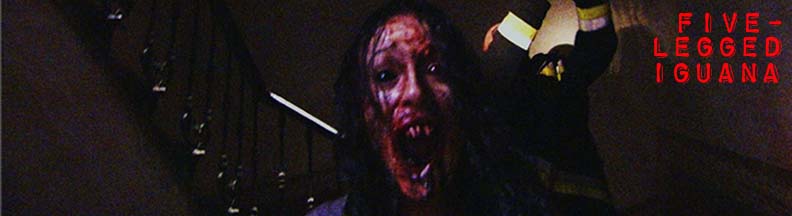
This very nearly breathless exercise in first-person, handheld POV horror sees Angela Vidal (Jennifer Carpenter) and her cameraman Scott Percival (The Practice’s Steve Harris) doing a piece for The Night Shift, where Angela gets to live her dream for a night—being a fireman.
Well, actually just shadowing a crew of firefighters, first in the station, during their downtime, and later on, when they’re called in for what turns out to be a medical emergency with horrifying ramifications, gradually turning her dream, yes, you guessed it, into a nightmare…


Under the very able and deft direction of John Erick Dowdle (assisted by his brother Drew, who’ve made the example of the Coen brothers their own career template), the palpable tension of a collection of people trapped in a building under very intense conditions is only too evident, as events spiral out of control and hysteria steadily escalates into maddening terror.
And while this is a piece of ensemble horror, credit needs to go to Carpenter, who should be familiar to you from Scott Derrickson’s The Exorcism of Emily Rose, as well as Showtime’s Dexter. As Angela, she’s practically onscreen for the entire length of the film, and is the audience’s “in” to the chiller’s narrative, the gamut of emotions she runs—excitement to anger to indignation to anxiety to balls-out shivering hysteria—mirrors our own, as things rapidly go from bad to oh-so-very-frakking-worse.


Though this doesn’t have the Cloverfield advantage of a cast of relative unknowns (thus heightening the suspension of disbelief), we do get Johnathon Schaech as the 70’s porn-mustachioed fireman Fletch.
And that’s a pretty fair trade-off, I think.
It’s also a credit to everyone involved with Quarantine (including DP Ken Sang and editor Elliot Greenberg, for making the cinematic sleights of hand invisible) that the film’s scares outshine that mustache, ‘cause it truly is a scarifying one, people.
There’s also a very neat Doug Jones appearance in here; trust me, you’ll know Dougie when you see him…


It’s interesting to note that the Dowdles co-wrote the Quarantine script working off [REC]’s Spanish script, since the adaptation began while [REC] was still being completed.
It was in the same week that they completed and presented their Quarantine script that they first saw [REC], and though it did then inform the subsequent development and shooting of Quarantine, this didn’t tread the usual path most remakes take.
And now that Quarantine has proven to be a very effective film in its own right*, it only makes me even more eager, to see both the original [REC], and its impending sequel, [REC] 2, which is said to give the material an Aliens spin, as camera-mounted military types enter the picture to clean up the bloody mess.
Woo-hoo! Fun times!!


* It’s a testament to the achievements of the Dowdle brothers—whose tag-team work on The Poughkeepsie Tapes got them the Quarantine gig—that they were handpicked by M. Night Shyamalan to kick off the “Night Chronicles” with Devil.
The Night Chronicles will encompass three horror films that will find their genesis in original stories by Shyamalan, to be scripted and directed by individuals chosen by him as well.
Devil is to be scripted by Brian Nelson, who’s worked with director David Slade twice, helping to adapt 30 Days of Night for the big screen, and before that, on Hard Candy.


Parting shot: Incidentally, Quarantine—and of course, [REC]—plays like an early Cronenberg mash-up, taking the setting, an apartment building, from one of his films which I haven’t seen (Shivers), and releasing the threat from one of his films which I have seen, and which is reviewed here at the Iguana.
Other films’ reviews accessible in the Archive are shakycam POV horror titles that followed in [REC]’s wake, Matt Reeves’ Cloverfield and George Romero’s Diary of the Dead; Jaume Balaguero’s features Los sin nombre, Darkness, and Frágiles; as well as films featuring Jones (Guillermo del Toro’s El laberinto del fauno and Hellboy II: The Golden Army) and Schaech (Gregg Araki’s The Doom Generation).
Schaech’s work on cable TV’s Masters of Horror is also tackled in the Archive.

(Quarantine Spanish OS courtesy of impawards.com; images courtesy of shocktillyoudrop.com.)

Tuesday, August 11, 2009


BOOK OF BLOOD
(Review)


“The dead have highways, running through the wasteland behind our lives, bearing an endless traffic of departed souls. They can be heard in the broken places of our world, through cracks made by acts of cruelty, violence, and depravity.
“They have signposts, these highways, and crossroads, and intersections, and it is at these intersections where the dead mingle, and sometimes, spill over into our world.”


For Clive Barker fans, the opening words which echo out from the black will be familiar, and for those diehards, I am extremely pleased to report that following Ryuhei Kitamura’s The Midnight Meat Train, John Harrison’s Book of Blood is another solid Barker film adaptation.
Based on the Books of Blood framing stories “The Book of Blood” and “On Jerusalem Street: A Postscript,” Harrison’s take follows visiting American professor and noted author, Mary Florescu (Heartbeat’s Sophie Ward), who investigates a purportedly haunted house in Great Britain, in the interests of her next book.
But when she asks for the help of one of her students, Simon McNeal (Jonas Armstrong, BBC’s Robin Hood), she sets off a chain of events that will bring her the long-sought after proof of the existence of the paranormal which she has been chasing after for the past decade.
And it won’t be a pretty sight.
Not at all.


Harrison and co-screenwriter Darin Silverman expand nicely on the pair of short stories, altering some motivations and personal histories in such a way as to enhance and reinforce the material for the purposes of this adaptation.
There’s much to be noted here, and Armstrong’s sad-eyed portrayal of the apparently “gifted” McNeal is one of the film’s central strengths, thankfully making up for whatever lack we may find in Ward’s Florescu.
Though her bravery in going starkers matches Armstrong’s commitment to his own role by freely dropping trou whenever called for, there’s still something seemingly tired and non-committal in Ward’s performance, which is quite probably the key drawback to Book of Blood; her iffy line delivery also slightly hobbles what could have been a stupendous opening. (Barker’s prose most definitely carries the day in that initial voice-over.)
Then again, Ashley Laurence wasn’t exactly Meryl Streep either, but that didn’t stop us from enjoying the first two Hellraisers, eh?
And if you still need a little convincing, Pinhead and Butterball* are in here too…


Though this is getting a theatrical release in other parts of the globe, that may very well not be the case in the USA. Sadly, even as Kitamura’s Midnight Meat Train got a bum American theatrical deal, Book of Blood (by virtue of it’s having been completed just as the global recession hit) is also looking like it’s going to have a major US cable launch this September, with a DVD release thereafter. There also could be a US theatrical release, though in late 2009 or even early 2010, via Lightning Media. (Whether wide or limited is still up for grabs.)
One can only hope that Anthony Diblasi’s upcoming Dread will have better luck in American theatres…
Till then though, this, along with Kitamura’s Midnight Meat Train now make for a nice double feature to celebrate the resurgence of Barker on the big screen.
Hurrah!


* Well, Doug Bradley and Simon Bamford, to be more precise.
And, having mentioned Simon Bamford, it’s rather appropriate that he has a role in the film adaptation, as Barker reportedly based the character of Simon McNeal on Bamford himself.

Parting shot: A review of The Midnight Meat Train can be found in the Archive.

(Book of Blood DVD cover art and images courtesy of shocktillyoudrop.com.)

Monday, July 20, 2009


SURVEILLANCE
(Review)


If you’ve been to the Iguana before, you’ll probably know that I’m a huge David Lynch geek. So it shouldn’t be surprising that when Jennifer Lynch’s Boxing Helena came around in 1993, I was on tenterhooks to see it, wondering how much of the bizarre could be passed on through the generations.
But, whether it was because I expected too much since she was Lynch’s daughter, or whether the production itself took an early (and unrecoverable) bad step in the whole Kim Basinger casting brouhaha, I came away from the film a sad, disappointed man.
The younger Lynch then fell off the cinematic radar till last year, when her Surveillance began to stir up much praise, winning the top prize at Sitges. (It also won the Best Director and Best Actress awards at the NYC Horror Film Festival; Lynch being the first female director to take the prize in the festival’s history, and Ryan Simpkins, the first child to win Best Actress.)
And now that I’ve seen it, I’m a very happy man, extremely glad that after all these years, my disillusionment with Boxing Helena has finally been washed away by this involving thriller.


The film centres on a violent incident along a stretch of highway in the Santa Fe desert and the three witnesses to it. An a$hole cop (Surveillance co-writer Kent Harper), a junkie (Zodiac’s Pell James), and a child (Simpkins, also seen in Sam Mendes’ Revolutionary Road) are asked to recount the incident (and their respective journeys leading up to that point), by the FBI agents (Julia Ormond; and Bill Pullman, who’d of course previously worked with David Lynch on the stunning Lost Highway) who’ve arrived to investigate the crime.
The fractured storytelling (three points-of-view; discrepancies between what is being said and what actually took place) affords much of what makes Surveillance so involving in its early section, with the witnesses’ convergence during the incident in question a bloody, violent, and unrelenting set piece.
Then…
Then we’re privy to what comes next…


There is much here that is Lynchian, particularly the characters and characterizations that are slightly off-centre, and it’s actually an element of the proceedings that Lynch uses to good effect, acting as partial camouflage for the twists the narrative takes during its course.
To everyone’s credit, the clues are there, and even if you suspect the nature of the shoe you’re just waiting to drop, the reveal is still brutally effective, the finale suitably bleak.


Though this is nominally a thriller, as with most of her father’s work, Lynch’s Surveillance does what the best horror movies should do, unsettle, disturb its audience.
Central to that aspect of Surveillance are the performances of Harper and French Stewart (who plays Officer Jim Conrad), who are the worst sort of cop you’d ever have the misfortune of meeting.
It’s the fact that most of the cops we see in the film range from flaming a$holes to annoying incompetents, that the departmental rivalry between the local law enforcement and the FBI becomes a wryly amusing sight.
The third act reveal then makes it positively perverse.


Lynch, like her father, knows a good musical moment, and gives The Violent Femmes’ “Add It Up” a neat spin during the proceedings. (Aside from executive producing, Daddy Lynch also provides the creepy-a$ “Speed Roadster,” portions of which are heard in the film’s main body, then heard in its entirety during the end credit crawl.)
She also knows how to visually captivate, and she’s ably assisted in this respect by DP Peter Wunstorf and editor Daryl K. Davis.
All in all, this is a stunning return for Lynch, and the fact that she chose her next project to be the Bollywood production Hisss (about a nāginī—a female nāga, or snakewoman), makes me grin even wider.
Whatever flaws I may have perceived in Boxing Helena, Surveillance is a cold, calculated diamond, proving quite decisively that the younger Lynch is a capable and rather gifted storyteller.
Hopefully, she has more bizarre cinematic jewels up her sleeve.


Parting shot: A double feature of Surveillance and David Fincher’s The Curious Case of Benjamin Button would be a blast, if only to showcase two very different sides of Ormond.

(Surveillance OS courtesy of impawards.com [design by Jeremy Saunders]; images courtesy of latimes.com & shocktillyoudrop.com.)

Friday, July 17, 2009


DØD SNØ
(DEAD SNOW)
(Review)


Norwegian director Tommy Wirkola kicks off Død snø (Dead Snow) to Grieg’s “In the Hall of the Mountain King,” and this rousing (yet vaguely sinister) tune ushers us—without much ado—into this fun Nazi zombie romp.
Yes, you read that right.
Nazi zombie.
How cool is that?!


A bunch of med students are off in the snow-capped mountains for Easter vacation, and, well, they run into those pesky Nazi zombies, and much screaming, and bloodshed, and running around (yes, these are post-28 Days Later deadheads) ensue.
Now, despite that smirk-guaranteed premise (Nazi. Zombie.), Død snø isn’t a horror-comedy on the order of Shaun of the Dead, but rather a horror film that straddles two sub-genres (the zombie romp and the isolated-cabin-in-the-wilderness thriller), with some comedic touches thrown in for good measure.
Think a more sedate version of a latter day Evil Dead installment, when the humour was quickly encroaching on the material. To be clear, there aren’t any Three Stooges or dismembered-hand-giving-the-hero-the-finger moments in Død snø (I did say “more sedate”). But there are some laughs and over-the-top insanity amidst the shouty, gory bits.


In point of fact, early on in Død snø, the horror film milieu is acknowledged, with Evil Dead actually mentioned, a cheeky swipe all in line with Død snø’s sense of fun within a horror movie context; it’s also a sentiment I happen to agree with, a feeling that’s been with me ever since I was vaguely disappointed after seeing Evil Dead 2 for the first time.
Of course, what Evil Dead 2 and Død snø share is that both are rather fun experiences at the cinema. That common trait notwithstanding, Død snø does have its shortcomings, among them, the vaguely insubstantial back story to the wild goings-on. (And yes, Evil Dead did have a very basic back story as well, but somehow, the rest of the audacious proceedings more than made up for its rather elementary nature.)


Still, Død snø does have its moments, and has piqued my interest, not just in a proposed sequel (here’s hoping Wirkola hits it spot on a second time out), but also the reported Hansel and Gretel: Witch Hunters, in which we find the titular siblings all grown up and having turned their childhood trauma into their livelihood. (In this case, I’m hoping Wirkola can get right what Terry Gilliam fumbled in The Brothers Grimm.)


(Død snø OS courtesy of twitchfilm.net; images courtesy of twitchfilm.net, empireonline.com, & shocktillyoudrop.com; Dead Snow OS courtesy of rushprint.no.)

À L’INTERIEUR
(INSIDE)
(Review)


And the French raze the house down once again…
There’s just seems to be something about France, extreme horror, and Christmas: Kim Chapiron did it in Sheitan, and now, it’s Julien Maury and Alexandre Bustillo’s turn to rain buckets of fake blood down on the holidays, in À l'intérieur (Inside).
Sarah (Alysson Paradis) is recently widowed, and scheduled to give birth on Christmas morning. First though, she must spend Christmas Eve alone, while riots and violence shake the city around her.
And to make matters worse… well… let’s just say matters are made worse. Very very much worse.


Now, since À l'intérieur is the sort of film that works best the less you know about it going in, I really shouldn’t say much more than that.
What I can say is that there’s some Hitchcock in here, along with some Argento, some Miike, and a smidgen of Cronenberg thrown in for good measure.
There’s also a discordant and unnerving score, courtesy of Francois-Eudes Chanfrault, who also penned music for Gilles Marchand’s Qui a tué Bambi? (Who Killed Bambi?), Alexandre Aja’s Haute Tension, Oliver Blackburn’s Donkey Punch, and Fabrice Du Welz’s Vinyan.


Make no mistake, À l'intérieur is extreme horror that brings the goods, a brazen bit of Grand Guignol that will find its audience riveted, watching slack-jawed over stretches of running time, as the onscreen atrocities—supervised by Jacques-Olivier Molon—just escalate to terribly ridiculous heights.
Either that, or they’ll simply flee to the bathroom to throw up whatever they’ve just eaten.


Pregnant women should not, I repeat, not come within a hundred metres of this one, and if you’re particularly fond of Christmas, you should probably steer clear of this too.
Yes, there are moments where the characters seem to forget the meaning of words like “phone” and “back-up,” but still and all, this one doesn’t mess about.
If you’re into loud horror that oozes and spurts, consider this a bloody present from Santa.
You have been warned.


Parting shot: After brief flirtations with the Halloween sequel and the impending Hellraiser reboot, Maury et Bustillo have instead chosen Livid to be their English-language debut. Livid is a dark fantasy with supernatural elements that sounds—at least to me—like it could wind up in Suspiria territory.
Bring.
It.
On.

Parting shot 2: Reviews of Sheitan, Donkey Punch, Vinyan, and Suspiria, for that matter, can be found in the Archive. There’s also The Children in there, which takes another brutal swing at the holidays.

(À l'intérieur OS courtesy of impawards.com; images courtesy of gomorrahy.com and shocktillyoudrop.com; Inside DVD cover art courtesy of shocktillyoudrop.com.)

Sunday, July 12, 2009


HORSEMEN
(Review)


“And when he had opened the fourth seal, I heard the voice of the fourth beast say, ‘Come and see.’”
-- Revelation 6:7


There are certain recurring elements that seem to be thrown at the viewer when the standard serial killer thriller/procedural is on hand: among them, some Bible bits, and a slew of disturbingly gruesome kills.
Se7en did it.
Millennium did it. A lot.
So it is that it takes quite a lot for me to get worked up over a serial killer thriller/procedural these days.
Now we’ve got Jonas Åkerlund’s Horsemen, which, admittedly, attempts to take the sub-genre a little further than it’s traveled before.


I’ve been following Horsemen’s trail for quite awhile now, tuning into the project after it looked like Jaume Balaguero was going to direct it for Platinum Dunes.
That ultimately didn’t work out though, and Horsemen instead fell into the lap of Åkerlund, whose last feature was the frenetic entry in the canons of drug cinema, Spun.
I rather liked Spun, so when news broke that Åkerlund was in the director’s chair, I was still determined to check out Horsemen.
And now that I have seen it, I must admit that while some of it works, some of it doesn’t.


Det. Aidan Breslin (Dennis Quaid) is a troubled cop whose specialty—forensic odontology—brings him to the fore of a case that quickly reveals itself as one where the perpetrators display a distinct fixation on the Four Horsemen of the Apocalypse.
Cue Biblical bits (complete with expository chat with the neighbourhood priest, played by Paul Dooley) and disturbingly gruesome kills (courtesy of the awesome K.N.B. EFX).
Those aspects, and the view we get of Breslin’s struggles on the homefront, particularly his fractured relationship with teen son Alex (Southland Tales’ Lou Taylor Pucci), are what work in Horsemen.
There’s also an attempt to portray a complicated plan that’s compromised by the very human nature of its perpetrators; we eventually see where the scheme buckles, despite the intentions of its mastermind.


Where Horsemen doesn’t work though is in its underutilization of some very capable actors (among them, Clifton Collins, Jr. and Peter Stormare).
We get a fine performance from Patrick Fugit (who’d previously worked with Åkerlund on Spun), but it’s limited to a short portion of the film, playing almost like a vignette in the context of the entire narrative.
In fact, there are elements of the script (by Dave Callaham, who’s also written the script for Michael Cuesta’s Tell-Tale) that just don’t seem to reach any manner of resolution, among them, the subplot that involves Zhang Ziyi.
Then there’s that ending, which plays like such a Hollywood copout, the sort of ending that isn’t earned at all, but somehow feels tacked on.


Granted, the perpetrators have a point to make, motivations that transcend the usual psychopathology of your average movie serial killer, but in the end, Horsemen just doesn’t cohere as well as I’d hoped.
Disappointing, considering my fondness for Spun.
At any rate, Callaham’s script showed a certain level of ambition, so I can only hope that his screenplay for Tell-Tale (a contemporary update of Edgar Allan Poe’s "The Tell-Tale Heart") will likewise strive for something more than your average Hollywood horror thrills.


Parting shot: With Cuesta at the helm of Tell-Tale, my hopes for it rise even higher…

(Horsemen OS courtesy of impawards.com; images courtesy of bad-taste-it.)